

A ribbon cutting makes the board report. The introduction that helped a member keep her doors open during road construction might never make it onto the page.
You hear about it when you call to thank her for hosting the ribbon cutting. A chamber ambassador shared how he’d rerouted his own deliveries, and she used his advice to keep serving customers.
That’s the kind of detail that can change what you prioritize next year. Add a couple of questions to your year-end thank-yous and find out what members actually used, what surprised them, and where they could use your help next.
Year-end thank-yous give you a natural opening. You’re already reaching out to recognize what members did for the chamber and the business community. With a few well-chosen questions, you can also learn what helped them, what caught them by surprise, and where they could use your help next year.
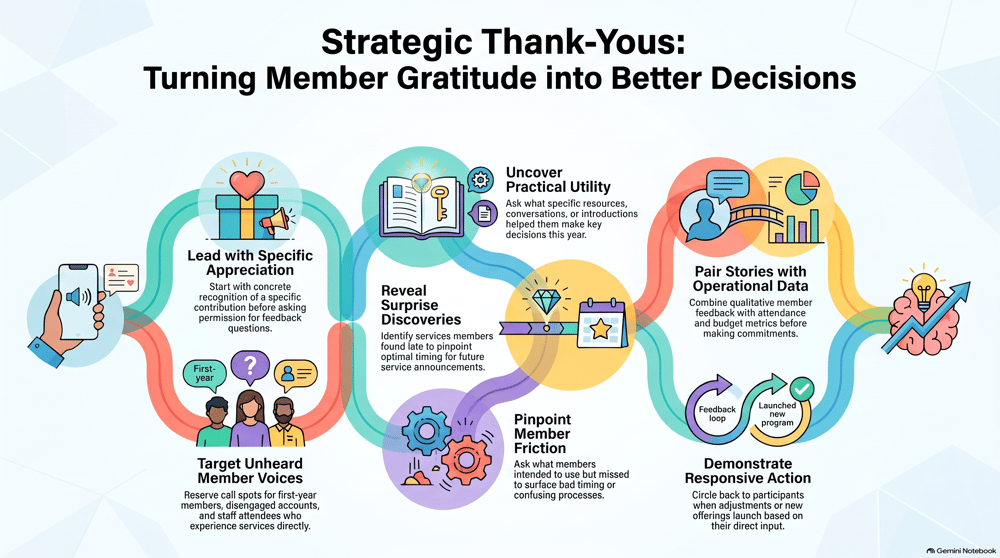
Give Thanks First
Start with something specific. “I wanted to thank you for sending two of your employees to help at the career fair. They gave students a chance to ask specifics about the work.” You can also thank a member for something quieter, like making time for a new business owner or sharing what a street closure meant for nearby shops.
Let them respond completely. Don’t jump in.
After they’ve finished responding to your appreciation, ask, “While I have you, I’d love to hear what was useful to you this year. Do you have time for a couple of questions?”
If they’re in the middle of a customer rush, let the thank-you stand on its own. You can always ask another day.
Choose a manageable mix of members. If you have room for eight calls, give some of those spots to members you rarely see. Try a first-year member, a longtime member whose participation has tapered off, and an employer who sends staff to programs but rarely attends personally. Ask the employee who attended a program what they took away from it. The person who pays the dues may have heard a different part of the story.
Audio Summary
Ask For a Specific Time
“How are we doing?” is easy to answer politely. “When did something the chamber did make your work easier this year?” sends the member looking for a specific moment. Give them a beat to think. If they need a nudge, mention an introduction, a timely update, or a resource they may have used. The first thing they remember could have happened well outside your event calendar.
Pick two or three questions from the following list and keep one follow-up handy. As any skilled interviewer will tell you, you’ll get more from staying with an interesting answer than from getting through the whole list of generic questions you wrote down to start the conversation.
What Did They Find Useful?
- “What did you get through the chamber this year that you actually used?”
- “Was there a conversation, introduction, or piece of information that helped you make a decision?”
- “What’s one chamber offering you’d make time for again, even during a busy week?”
If they say, “The hiring roundtable was great,” follow-up with something specific like, “What did you do differently after it?” You might learn that they rewrote a job posting using a peer’s example. That’s a better clue about what to repeat than a compliment about the session.
What Surprised Them?
- “What did you discover this year that you didn’t realize the chamber could help with?”
- “Was there something you almost skipped that turned out to be worth your time?”
- “What did you find out that this year that you wish you’d known sooner?”
Follow up with “How did you finally hear about it?” If a member first learned about your permitting resource from another business owner six months after joining, you have a clue about when and where to explain that service. You might bring it up when a business announces a move or expansion, when the information has a job to do.
What Could They Use More Of?
- “What’s one decision or challenge coming up for your business that you’d like help with?”
- “Which resource, connection, or program would you use more often if it were easier to access?”
- “If we could make one thing easier for your business next year, what would you pick?”
When someone asks for more networking, find out who they hoped to meet and what they wanted to talk about. A retailer looking for neighboring businesses to share promotion costs has a different goal from a manufacturer looking for a local supplier. A few well-matched introductions may give both what they need.
Listen For Where Members Got Stuck
A member who rarely engages may have plenty to tell you. “Was there anything you meant to use this year and never got around to?” can surface a registration process they abandoned, an event time they couldn’t make, or a benefit they assumed was reserved for sponsors.
If a member says they never know what’s coming up, ask where they usually look and when they decide how to spend their week. You may discover they see your Thursday newsletter after they’ve already set the following week’s staff schedule. Moving a few announcements up could make participation possible for people who were interested all along.
Sometimes the conversation will reveal an issue you can resolve immediately. If a member couldn’t update their directory listing, help them get it fixed. Then check whether other members are getting stuck at the same step. One call can save a member time today and point you toward a fix that saves staff time next year.
Bring the Stories into Your Planning Meeting
After each call, record (write it or speak it, whatever will ensure you capture the information) what the member used, what happened as a result, what got in the way, and what they need next. Add enough context to see whose experience you’re hearing, such as a new retailer or a longtime employer.
When you sit down to plan, put those notes alongside attendance, usage, and staff time. If several owners say they relied on your construction updates, look at which details helped them act. Maybe they forwarded the delivery access maps to vendors and shared reopening dates with customers. That gives you a case for keeping the updates and asking your city contact to send those details earlier.
Even a small set of calls can reveal problems worth investigating. Before making a budget or calendar commitment, check how widely the issue shows up. If several members want an evening workshop and your morning sessions already draw well, try offering one existing workshop at a different time. See who comes.
Give each decision a next step and someone to own it. A solo chamber director could reserve 30 minutes in January to review the notes and pick one change to test. A team could bring two patterns to its planning meeting, assign the follow-up, and set a date to look at the results.
If you’re taking a decision to the board, pair the member experience with the staff time or budget involved. “Three owners used our updates to reroute deliveries, and we can get the maps out sooner with one change to our process” gives the board something concrete to discuss.
Let Members See Their Input in Action
When you act on what you heard, circle back. “You mentioned it was hard to get away for a morning workshop. We’re trying an evening session in February, and I thought you’d be interested.”
If a member asked for something you can’t take on, be direct about what’s feasible. You may be able to make an introduction or point them to a partner that already offers what they need.
Then pay attention to what happens next. Did the evening workshop bring in owners you seldom see? Did earlier construction updates give businesses enough time to tell customers where to park? Those are questions you can bring into your next round of thank-yous. And the next time you call the owner who borrowed that delivery idea, you’ll have a better opening than “How are we doing?” Ask her what she’d pass along to the next business facing a street closure.
Share this post...
Most Recent Posts
Use year-end appreciation conversations to learn what members found useful, what surprised them, and what they want more of.

They're not all winning "Business of the Year but that doesn't mean they don't deserve your appreciation.

Engaging chamber members in the middle years is easier than you think.

You see the perfect partnership, make the introduction, then nothing. Here's how to fix that.

Create or modify your chamber's policies and procedures doc easily with AI

Your board has lots of ideas but they're not always great. Here's what to do when they aren't.

Holidays are crazy so is the job of a chamber pro. Here's how to navigate both.

What if a board member asks to start posting to the chamber?

Short on time to plan a chamber celebration? These ideas will help you spotlight members, involve your board, and showcase useful benefits in just 1-2 days.

Do people use your member directory? Learn how to get them more involved.

The first ten minutes are the most important part of your event. Here's how to make them better.
To attend or not to attend? That's the question that chamber pros ring in on.
CONTENT
Subscribe to the Chamber Pros Community Online Newsletter.
Discover chamber tips, strategies, and best practices...
We value your privacy and will never sell your info
Legal Agreements, Privacy Policy, Terms and Conditions
Copyright 2026 Chamber Pros Community and Frank J. Kenny, LLC