

Newbies get all the love; just look at the cable company or cell service provider. Specials everywhere for the new customer.
Sometimes chambers do the same thing. A new member gets a welcome email campaign, a few introductions, maybe some swag, and gets fawned over at orientation. But by year three, chamber communication to that same member may be mostly through the newsletter and renewal notices.
From your side, the relationship looks stable. They’re paying their dues. Nobody’s called with a complaint.
But from the member’s side, the business may look completely different. They’ve hired a manager, added a service or lost the employee who used to go to chamber events. The chamber is still sending opportunities based on what it knew when they joined.
That’s what makes the middle years awkward. You know the member well enough to assume you know what they need. They know the chamber well enough to assume they’ve seen what you offer.
A conversation can change both assumptions.
Audio Summary
1. Ask What’s Changed Since They Joined
You probably asked new members why they joined. Give yourself a chance to ask a different question once they’ve had time to use the membership.
“What’s changed in your business since we last talked?”
It’s an easier question to answer than “How can the chamber help?” That’s because most members don’t know. If they did, they’d ask for it specifically.
But what they can tell you easily is things like they’re opening a second location or struggling to get in front of a different kind of customer. Figuring out how that connects to the chamber is where you come in.
Imagine a photographer joined to book more family portraits and is now pivoting to commercial work. You could send them the events calendar or you could ask which kinds of businesses they’d like to photograph and offer to make one relevant introduction. The second approach gives the photographer a reason to engage with the chamber again, even if they’ve already attended every mixer on the calendar.
Leave yourself a short note in your CRM about what changed and what you offered. That way, the next time someone from the chamber reaches out, they can pick up the conversation without asking the member to start over.
2. Give Them a Fresh Way In
Sometimes a member drifts because the way they originally participated no longer fits. The owner who once came to breakfast now handles the morning shift. The office manager who attended everything has moved on. A business that joined for networking has made plenty of contacts and is ready to work on a community issue.
Offer one way back in that fits the business today. If the owner’s mornings are booked, see whether a colleague would benefit from attending. If the longtime attendee wants a more substantive role, ask them to weigh in on an issue their business knows firsthand.
Keep the invitation specific. “Would you spend 20 minutes with us talking through what makes deliveries difficult downtown?” is a much easier request to consider than “Would you like to get more involved?” It also gives the member a clear idea of why you thought of them.
3. Look Beyond the Event Sign-In Sheet
If attendance is your easiest engagement metric, the members you see most can start to look like the members getting the most from the chamber. Even if they originally attended every event, and now they don’t, doesn’t mean they’re disengaged. It’s possible their business or staff have changed.
A business that rarely sends anyone to an event may rely on your policy updates, use the directory to find local vendors, or send job openings to your team.
Before you label a member disengaged, look at the interactions you can see. Have they responded to a survey? Asked for a contact? Updated their directory listing? Used a resource you sent? Opened every email? A quick look can help you tell the difference between a relationship that needs attention and one that’s working, if only quietly.
When you’re unsure, ask how they use the chamber now. A member might tell you that your road construction updates help them plan deliveries. That’s worth remembering the next time you’re deciding what to send them or which businesses to consult about a proposed traffic change.
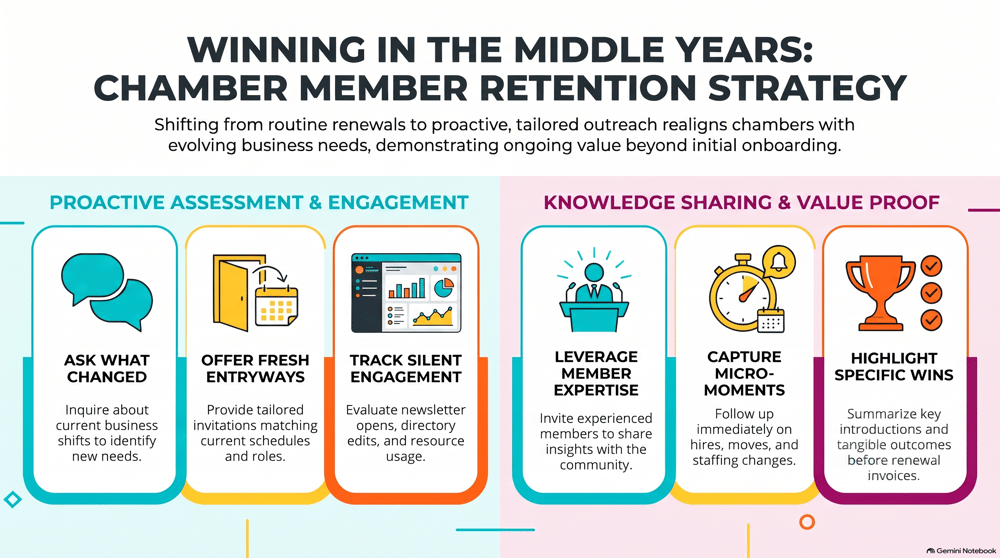
4. Use Established Members as a Knowledge Base
New members spend a lot of time learning how the chamber and the community work. A few years in, they likely have something to teach. That creates a different reason to stay involved.
Ask a retailer who’s been through a downtown construction project what helped customers find the store. Invite a manufacturer to share what made its first school partnership work. Ask a business that recently expanded what it wishes it had known six months earlier. You can turn what they share into a short newsletter feature, a roundtable discussion or a practical resource for the next business facing the same decision.
Match the request to the person. Some members would love a microphone. Others would rather answer three questions by email or talk you through a problem over coffee. And when you use their input, close the loop. “We added your suggestion to the guide” gives them a concrete example of how they helped another business. And that feels good.
5. Build a Habit Around Community News
You can learn a lot about a member’s next chapter from a ribbon cutting announcement, a job posting or a quick conversation at the grocery store. The hard part is doing something with what you learn.
If you hear that a member has hired a new sales director, congratulate them and ask whether that person should receive chamber invitations. If a business is moving across town, see whether they need to update their directory listing and offer to connect them with nearby businesses. If your usual contact leaves, find out who should receive chamber communications and give that person a short introduction tailored to their role.
For a solo chamber pro, this can be as simple as setting aside 30 minutes a week to follow up with two members. If you have a team, give one person ownership of each follow-up. The front desk may hear about the move first, the events person may know the new contact and the membership person may have the account history. One owner makes it easier for those details to turn into a useful conversation.
6. Give Members Something to Remember at Renewal
By the time an invoice hits, a busy owner may have forgotten who made the introduction that led to a new vendor or where they got the information that helped them plan around a street closure. A brief recap can connect those dots, especially if you use details the member will recognize.
Try something like this a few weeks ahead of renewal. “When we talked in March, you were looking for a local packaging supplier. We introduced you to two businesses, and you mentioned you’d started working with one of them. You also said you were hoping to meet more independent retailers this year. Is that still a priority?”
Only claim what you know. If you made the introduction and never heard what happened, ask. The answer may give you a success to record, a chance to help again, or a better understanding of what the member was looking for in the first place.
If the member tells you they got very little out of the year, ask what would make the next few months worthwhile. Agree on one reasonable action and a date to check back. Following through on that promise gives them something specific to weigh when they decide whether to renew.
7. Start With the Member You Assume Is Fine
Pick one member who’s renewed a couple of times and rarely asks for anything. Look up why they joined, then reach out with one question about what’s changed. Listen for something you can act on this week, such as an introduction, an invitation, or a resource they can put to work.
A few months from now, when that member is asked what they get out of the chamber, they’ll know.
Share this post...

Get support, tools, and extra hands working alongside you.
Additional Chamber Resources & Support
Join 12,500+ Chamber Pros in the Chamber Pros Community Facebook Group

Ongoing support, live training, Learning Hub access, and AI Co-Workers
Done 4 You Social Media Content for Your Chamber

Board Retreats, Strategic Planning, Orientations, Speaking, & Consulting


Explore Additional Content in These Categories
Most Recent Posts
Engaging chamber members in the middle years is easier than you think.

You see the perfect partnership, make the introduction, then nothing. Here's how to fix that.

Create or modify your chamber's policies and procedures doc easily with AI

Your board has lots of ideas but they're not always great. Here's what to do when they aren't.

Holidays are crazy so is the job of a chamber pro. Here's how to navigate both.

What if a board member asks to start posting to the chamber?
Meet Our Authors



CONTENT
Subscribe to the Chamber Pros Community Online Newsletter.
Discover chamber tips, strategies, and best practices...
We value your privacy and will never sell your info
Legal Agreements, Privacy Policy, Terms and Conditions
Copyright 2026 Chamber Pros Community and Frank J. Kenny, LLC