

“I just want to post when I’m out and about visiting businesses.”
It sounds helpful. Your board member already visits local businesses, enjoys taking pictures, and wants to promote the chamber. Sounds harmless enough, right?
Handing over access might feel like crossing something off your list. And they’re out there doing the work anyway. Why not give them direct access to your audience?
But before you choose the “easy” way and hand it off, ask yourself, “Who will be responsible for what this person publishes?”
If that answer is still you, the offer deserves a conversation before anyone gets access.
A board member can be an excellent source of stories, photos, and community connections. Whether they should publish directly to the chamber’s accounts depends on their skills, your board’s role, and the process you have for managing communications.
The strongest default is simple: welcome their contributions and keep publishing access tied to an assigned responsibility.
Audio Summary
Understand What They’re Offering
Before responding, find out what the board member hopes to accomplish.
Do they want to help businesses get discovered? Show the chamber supporting members? Reach people who don’t attend events? Or do they believe your accounts need more activity?
Those are different conversations.
You also want to try and understand their personal motivation because they could just post it to their own account and tag the chamber. Maybe they want to increase their personal reach, be seen as a mouthpiece of the chamber, especially if they want to identify themselves as the poster. Maybe they don’t feel like their personal audience would be interested in chamber affairs.
Whatever the reason ask, “What kinds of visits would you want to share, and what would you want someone seeing the post to do?”
Their answer may reveal a useful opportunity. Perhaps your feed has plenty of event promotions but rarely shows what members do. Perhaps the board member has relationships with businesses your staff struggles to reach.
You can appreciate that insight without immediately granting publishing privileges.
Real Advantages to Involving The Board
Board members can extend your chamber’s reach into the community. A staff of two can only visit so many businesses in a week. Board members may spot (or be privy to) stories you’d otherwise miss: a manufacturer expanding its training program, a retailer celebrating an anniversary, or a restaurant owner collaborating with another member.
Their participation can also make chamber leadership more visible and approachable. Members get to see directors taking an interest in their businesses between board meetings.
And a board member with professional communications experience may bring useful expertise. Someone who understands audience development, brand standards, tone, accessibility, and business goals could contribute meaningfully to your content.
Direct publishing can make sense if you have a working board and that person fills a defined communications role, has demonstrated the necessary skills, and follows an agreed process.
The advantage comes from the arrangement you build around the contribution. Enthusiasm alone won’t do that work.
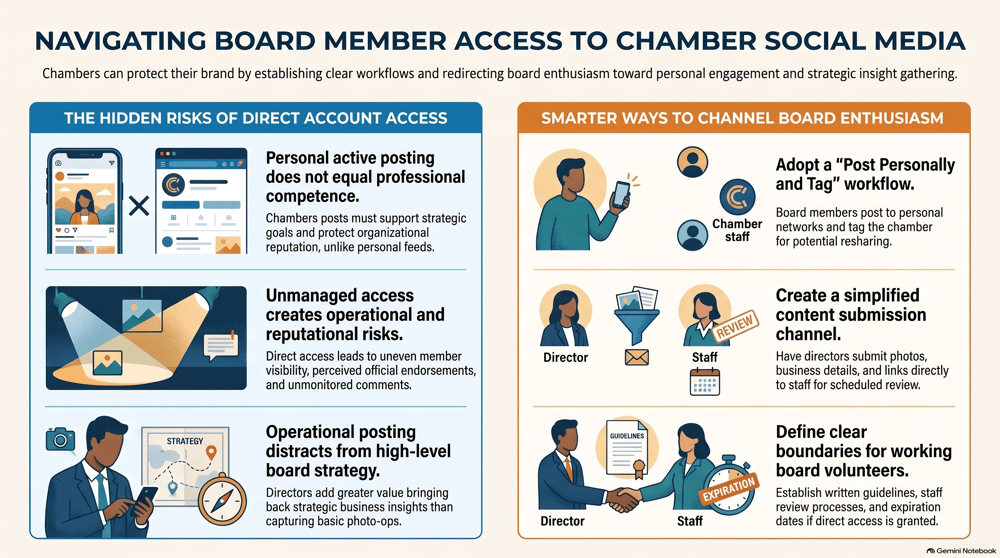
Being Active on Social Media Doesn’t Equal Professional Competence
Someone can be engaging on their personal account and struggle to communicate effectively for an organization.
Personal posts often serve a straightforward purpose: share an experience, express an opinion, or start a conversation. Chamber posts need to support an organizational goal while accounting for members, sponsors, prospects, community partners, and the chamber’s reputation.
Consider the difference between these captions:
“Stopped at this amazing shop today. Love these people.”
And:
“Looking for gifts you can personalize locally? Chamber member X’s Shop offers custom engraving and in-store pickup. Here’s how to order.”
The first is valuable but the second gives readers useful information and a next step. Depending on your communications goals, it may do more for the business than a smiling photo and a compliment.
Effective chamber social media also involves judgment about accuracy, timing, permissions, tone, and responses. A popular personal account doesn’t tell you whether someone can handle those responsibilities.
Neither does a seat on the board.
The Risks Reach Beyond an Awkward Caption
Before allowing direct access, consider what could happen after that first business visit.
Member visibility can become uneven. A board member naturally visits businesses they know and enjoy. Over time, the chamber feed could become a record of one person’s shopping habits. Other members may reasonably wonder how to receive similar attention.
You don’t need identical coverage for every member. You do need a defensible way to choose what you feature.
Personal enthusiasm can sound like an official endorsement. “The best financial adviser in town” carries different weight on a chamber account than on someone’s personal page. Superlatives, product claims, and recommendations deserve scrutiny when the organization appears to make them.
Relationships can complicate the picture. A board member might feature a client, a relative’s business, their own company, or a close referral partner. Even a well-meant post can create questions about preferential treatment.
Photos and details should be checked. Did the owner agree to the photo? Is that expansion public yet? Does the image show customers, children, private paperwork, or something the business would prefer to keep out of view? A friendly visit doesn’t automatically make everything publishable.
Someone must manage the response. A business feature might attract questions, complaints, or an argument. Who monitors the comments? Who answers? Who decides when a response needs the CEO’s attention?
Access creates an ongoing responsibility. You’ll need to assign appropriate permissions, protect account security, and remove access when the role ends. Avoid shared passwords. Use individual access with the narrowest permissions available for the assigned work.
The original offer may take ten seconds to make. The responsibilities continue after the post goes live.
But the biggest reason to avoid this may be….
Board Member Is a Strategic Role
For a governing board, a member’s greatest contribution generally comes through strategy, oversight, relationships, and organizational leadership.
A board member visiting businesses can help answer questions your chamber needs to explore:
• What pressures keep coming up in member conversations?
• Which businesses feel disconnected from chamber programs?
• Where could an introduction or partnership create an opportunity?
• What are members asking for that the chamber hasn’t addressed?
Those observations can inform retention efforts, programming, advocacy priorities, and strategic planning.
If every visit becomes a photo opportunity, they may confuse their role and the chamber may miss the more useful work and insights.
You can redirect the board member toward that larger contribution: “Photos would be helpful. I’d also love to hear what those owners say they need from us. You’re able to bring back insights we might otherwise miss.”
A director who uncovers a recurring workforce problem may contribute far more than one who publishes six additional posts.
What About Chambers With Working Boards?
Some chambers rely on directors to staff events, recruit sponsors, answer inquiries, and manage communications. Telling those chambers to keep board members out of operations won’t reflect how they function.
A working board member may be exactly the right person to help with social media, but it can be a slippery slope that confuses board and staff assignments.
Give the volunteer a defined role. For example, a director might collect two member stories each month, draft captions using a simple template, and submit them for review. An experienced volunteer might receive permission to publish approved content.
Make the distinction between board authority and the volunteer assignment explicit. Holding a board seat shouldn’t allow someone to bypass the communications process.
Working boards also need to watch how operational tasks consume their attention. If directors spend all meeting debating photos and captions, you’re losing something valuable. Set aside and focus on time for finances, membership trends, leadership, and the chamber’s direction first.
The posts have a place but so does the future of the organization.
Offer a Better Way to Participate
For many chambers, the easiest solution is also useful for community reach.
Encourage the board member to share business visits through their own account and tag both the business and the chamber.
They might write:
“Visited Delioso Bakery this morning and learned they’re adding catering for local offices. As a chamber board member, I love hearing how our business community is growing. Check out their new menu.”
That introduces the business to the director’s network and gives the chamber an opportunity to review the content for possible sharing.
Make two expectations clear. First, a tag doesn’t guarantee the chamber will share the post. Second, directors should distinguish personal observations from official chamber statements and follow applicable board conduct policies.
Tagging also isn’t a reliable submission system by itself. Notifications can get missed. If the director wants the chamber to consider a story, ask them to send the photo and details through your designated channel.
Make Contributing Easy
If your alternative requires a lengthy form and three rounds of follow-up, the board member may stop sending anything.
Ask for a few useful details:
• Business name and correct social media handle.
• One or two clear photos the business has agreed you may use.
• What’s new, interesting, or helpful to customers.
• A relevant link or next step.
• Any timing restrictions or relationship the chamber should know about.
Set a realistic expectation: “We review submissions weekly and choose posts based on our content calendar and communications goals.”
You can also introduce a recurring feature with clear selection criteria. That gives staff a manageable format and gives contributors something specific to look for.
How to Let Them Down Without Shutting Them Down
Keep the response appreciative, direct, and grounded in a process that applies to everyone.
Try:
“I’d love for you to share what you’re seeing when you visit businesses. Post on your page and tag us and the business. That helps reach people who might not follow the chamber yet, and we can look for opportunities to share it. We’ll keep posting to the chamber’s accounts in-house so we can manage the schedule and make sure we’re giving a range of members attention.”
If they push back with “I’m only trying to save you time,” acknowledge the intention:
“I appreciate that. The biggest time-saver would be sending us a usable photo, the business’s correct information, and a few details about what you learned. That gives us content we can work into the schedule.”
For a working board, you can offer a more formal assignment:
“We could use help gathering member stories. Let’s define the role, the review process, and the time commitment so you know exactly what you’d be taking on.”
Avoid pretending that a universal legal rule prevents access or suggesting that the board member simply can’t be trusted. Explain how the chamber manages its communications and give them a productive way to contribute.
If You Do Grant Access, Define the Arrangement First
Agree on the purpose, permitted content, approval requirements, member selection criteria, comment responsibilities, and process for correcting mistakes. Include an end date or review date for the assignment.
If you have a communications style guide or tone, share that. They don’t have to sound exactly like the chamber, if they’re identified as the poster, but they shouldn’t sound so different that people don’t recognize the organization.
Start with draft submissions if you haven’t seen the person’s work. Review whether their contributions help members and reduce staff workload. If editing, factchecking, and managing expectations create more work than the arrangement saves, adjust it.
Your next step can be small: invite the board member to send one business story through the proposed process.
You’ll learn how they gather information, how much editing the content needs, and whether they welcome direction. They’ll get a concrete way to help. And you can make an informed decision before a generous offer becomes a nightmare.
Share this post...
Most Recent Posts

Use year-end appreciation conversations to learn what members found useful, what surprised them, and what they want more of.

They're not all winning "Business of the Year but that doesn't mean they don't deserve your appreciation.

Engaging chamber members in the middle years is easier than you think.

You see the perfect partnership, make the introduction, then nothing. Here's how to fix that.

Create or modify your chamber's policies and procedures doc easily with AI

Your board has lots of ideas but they're not always great. Here's what to do when they aren't.

Holidays are crazy so is the job of a chamber pro. Here's how to navigate both.
What if a board member asks to start posting to the chamber?

Short on time to plan a chamber celebration? These ideas will help you spotlight members, involve your board, and showcase useful benefits in just 1-2 days.

Do people use your member directory? Learn how to get them more involved.

The first ten minutes are the most important part of your event. Here's how to make them better.

To attend or not to attend? That's the question that chamber pros ring in on.
CONTENT
Legal Agreements, Privacy Policy, Terms and Conditions
Copyright 2026 Chamber Pros Community and Frank J. Kenny, LLC