

Someone on your board just emailed a subject line of, “Wouldn’t it be fun if we…” and you sigh before you’ve even opened the email.
You’re still finalizing the holiday mixer, chasing a sponsor’s logo, answering questions about shopping local, and trying to figure out how you’re going to make it through the end of the year. Somewhere in there, you’d also like to experience a holiday yourself.
Chamber work gets especially crazy this time of year. Members need visibility. They have last-minute goals that they haven’t thought about since January. Community partners need help. Year-end responsibilities keep coming. There are partes, festivals, and school programs you need to attend. Every worthwhile idea on the “must-do” list seems to arrive with an impossible deadline.
You care deeply about your community and your full calendar makes it feel impossible to get through the season and it hasn’t even (technically) started yet.
How will you make it through?
One step at a time.
Audio Summary
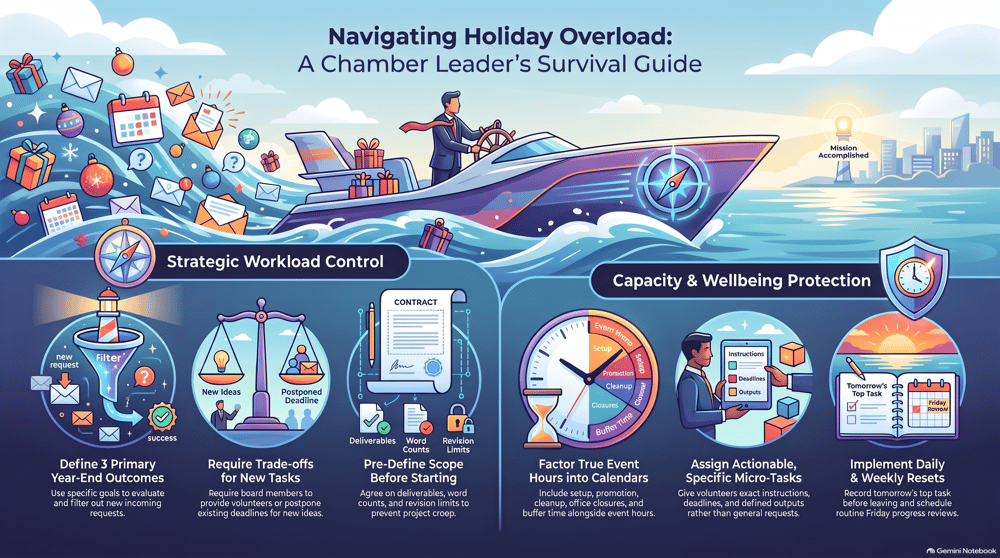
Decide What a Successful Season Requires
Before you add another project, finish this sentence: “By the end of December, our chamber needs to…”
Choose three outcomes. Yours might include fulfilling sponsorship commitments, helping residents discover/use local businesses, and completing renewal outreach before year-end.
Be specific enough to guide decisions. “Support members” leaves room for almost anything. “Run a consistent local-business campaign through Small Business Season and connect residents to participating businesses” gives you something manageable to deliver.
Use those outcomes to evaluate requests. Will a proposed activity advance one of them? Does it meet an existing obligation? What will it require from staff?
A good idea can still belong in January. Keep a future-project list so you won’t forget it when its time arrives.
Give the Calendar a Capacity Check
As every chamber pro knows, a holiday event that lasts two hours may consume two days of work. There’s registration, promotion, setup, sponsor coordination, name badges, cleanup, and follow-up. And let’s not forget how long it takes to find the extension cord.
Put that work on the calendar along with the event.
Add office closures, staff vacations, board deadlines, payroll responsibilities, and your own family commitments. For small teams, one person’s afternoon off can change what everyone else can reasonably accomplish.
Then leave some room unassigned. A schedule that requires every day to go perfectly will fall apart with the first cancellation or urgent member issue.
If you’re already over capacity, identify what you’ll simplify, delegate, or postpone before the next request arrives. An overloaded calendar won’t become manageable through optimism.
Make New Requests Come With a Tradeoff
“Can we squeeze this in?” sounds harmless until you’re the person doing the squeezing. When a board member, committee, or community partner proposes something new, explain what it would take and offer a workable choice.
For example:
“We can add the holiday window contest if a volunteer handles business recruitment and judging. Staff can promote it through our existing campaign. We don’t have time to coordinate the whole project this year.”
Or:
“We can move that ahead of the renewal outreach. Let’s decide together which deadline can change.”
These conversations work best before anyone promises the project publicly. Ask your board chair and committee leaders to check staff capacity before announcing new chamber activities.
If you have a working board, assign complete responsibilities. A board member who offers to “help with sponsors” needs a prospect list, a deadline, approved materials, and a clear handoff. Otherwise, you may spend more time managing the help than doing the task.
Stop Building Every Holiday Message From Scratch
A blank social media calendar can absorb an astonishing amount of time. You need an idea, an image, a caption, a link, and enough uninterrupted attention to put them together. Repeat throughout November and December. It’s a lot.
The Small Business Season program can take some of that production work off your plate. The campaign runs November 1 through December 31, 2026. Its free Basic level includes seven images and one professionally written article each week, plus a two-month content calendar, printables, and other marketing resources. The Professional level, at $97, adds prewritten social posts, Canva templates, a member media kit, radio scripts, and a web app that organizes campaign materials.
Use those resources to replace work you’d otherwise create yourself.
Reserve a recurring block to review the materials, add relevant local information, and schedule your selected content. Link readers to your directory, a participating-business page, or another useful destination. Give members one straightforward way to join the effort.
You can also make the campaign relevant across industries. Suggest local catering for an office gathering, gift certificates for services, or purchases from local professional and home-service businesses.
The time you save can go toward conversations with members, sponsor follow-through, or leaving the office when you planned to.
Define “Finished” Before You Start
Holiday projects have a way of expanding while you’re working on them.
A simple business roundup becomes a custom gift guide. The guide needs original photography. Someone suggests a video. Suddenly, a newsletter feature has acquired a Hollywood production schedule.
Before starting, agree on the scope: where the piece will appear, what information you need, who approves it, and when it’s finished.
For a holiday business roundup, that might mean one submitted photo, 50 words per business, one submission deadline, and one review. Put those requirements in the invitation.
Match the polish to the purpose. Check names, dates, links, sponsor commitments, and essential details carefully. Give yourself permission to stop once you get to what’s been agreed upon. Stop picking it apart. Stop adding to it. Just stop and get it out there.
The community needs accurate, useful information.
Delegate Something People Can Finish
“Could someone help with the holiday campaign?” is asking a volunteer to invent a job before agreeing to and doing it.
Try: “Could you contact these ten businesses by Thursday, confirm their holiday hours, and enter the information in this sheet?”
A useful assignment includes a task, deadline, instructions, and a definition of completion. It also identifies decisions the person can make independently.
• Ambassadors might collect business photos.
• Committee members could confirm event details.
• Board members could make thank-you calls to sponsors.
For a one-person chamber, start with a reliable person and one repeatable task. Don’t take on a massive overhaul of assignments during a stressful time.
Keep account permissions appropriate to the task. Someone collecting photos can submit them to a shared folder without needing access to publish on your chamber’s channels.
Reduce the Questions You Answer Repeatedly
If you’ve explained the holiday promotion deadline six times, create one place where people can find it.
A simple webpage or shared document can include submission instructions, event registration, participation requirements, office closures, and contact information. Put the link in campaign emails and save a short response you can reuse.
Publish deadlines early. Explain what happens after them.
“Send your information by November 10 for inclusion in the first roundup. Later submissions will go into the next available update.”
That gives people a route forward while protecting the work you’ve already scheduled.
Decide what qualifies as urgent, too. A broken registration link for tonight’s event needs attention. A request to change next month’s graphic can wait for your next communications block.
Protect the Person Doing the Work
Lunch, a walk, a moment to catch your breath, and a reasonable stopping time deserve space in your schedule.
Choose a few habits you can maintain during busy weeks. Take ten minutes away from your screen between demanding tasks. Eat before an evening event. Keep water and something substantial to eat at the office. After a late chamber function, adjust the following morning’s workload when possible.
Build a short transition between work and home. Before you leave, write down tomorrow’s first task and capture anything unfinished. You’ll know where to begin without mentally rehearsing your entire list or asking, “Now, where was I?.”
If you lead a team, your behavior sets expectations. Sending routine requests late at night can make people feel they should be available then, even if you say otherwise. It adds to their stress level and interrupts their relaxation. If you simply must send it because you’re worried you will forget, schedule the message or email for working hours.
You can also decline an invitation without submitting a defense brief. Thank the host, say you can’t attend, and consider whether another chamber representative would be appropriate.
Your presence matters but so does your ability to keep doing the job well.
Give Friday a Fifteen-Minute Reset
Before the week ends, review a few things. Choose the next week’s three most important results. Check for missing information, stalled approvals, and commitments that need to change. Tell the affected people early.
Notice what you completed, too. Chamber work often involves solving problems that disappear once you handle them. Record a few of those outcomes for your board updates and your own perspective: the sponsor who renewed, the member who got a useful introduction, the promotion that sent people to a local business.
Then close the list.
Before you tackle your next holiday project, get things streamlined. Make enough room to do the work your members need, not everything that needs to be done in your community. Finally, remember this is a magical time that happens once a year. You deserve some time to enjoy it.
Share this post...
Most Recent Posts

Use year-end appreciation conversations to learn what members found useful, what surprised them, and what they want more of.

They're not all winning "Business of the Year but that doesn't mean they don't deserve your appreciation.

Engaging chamber members in the middle years is easier than you think.

You see the perfect partnership, make the introduction, then nothing. Here's how to fix that.

Create or modify your chamber's policies and procedures doc easily with AI

Your board has lots of ideas but they're not always great. Here's what to do when they aren't.
Holidays are crazy so is the job of a chamber pro. Here's how to navigate both.

What if a board member asks to start posting to the chamber?

Short on time to plan a chamber celebration? These ideas will help you spotlight members, involve your board, and showcase useful benefits in just 1-2 days.

Do people use your member directory? Learn how to get them more involved.

The first ten minutes are the most important part of your event. Here's how to make them better.

To attend or not to attend? That's the question that chamber pros ring in on.
CONTENT
Legal Agreements, Privacy Policy, Terms and Conditions
Copyright 2026 Chamber Pros Community and Frank J. Kenny, LLC