

Hiring for a chamber of commerce can be deceptively difficult. You want to hire someone with business acumen, but the salary most chambers pay is often not consistent with other businesses looking for leaders.
On paper, the job may look straightforward: support members, coordinate events, manage communications, recruit businesses, and keep programs running.
But chamber employees are also community connectors, customer service professionals, event producers, salespeople, problem solvers, and diplomats.
That combination is hard to find in one person, especially when chamber salaries may be competing with larger companies, local government, and well-funded nonprofits.
Still, great chamber employees are out there. Finding them begins with understanding what the chamber needs, where those candidates may be hiding, and how to recognize potential that doesn’t (always) arrive in a perfect package.
Audio Summary
Define the Job You Actually Need
When an employee leaves, it’s tempting to pull out the old job description, change the date, and post it. But the role may have evolved significantly since that description was written.
Before advertising the position, examine the work that needs to be done now.
What results should this person produce during the first year? Which responsibilities require experience, and which can be taught? What qualities would make someone successful within your chamber’s culture and community?
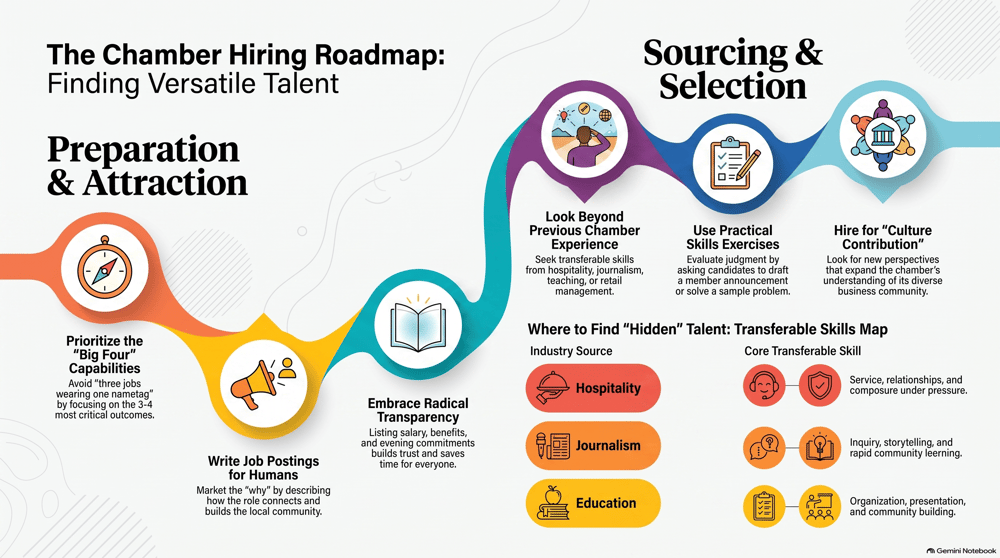
Separate the requirements from the wish list. A position that supposedly requires event planning, graphic design, sales, bookkeeping, public speaking, social media strategy, database management, and legislative expertise may be three jobs wearing one nametag. It’s common for chamber pros to wear multiple hats.
But that’s why you need to prioritize the three or four capabilities that matter most. This will help you write a clearer posting and avoid eliminating strong candidates who meet the chamber’s real needs but not every item on an unrealistic checklist.
Write a Job Posting That Sounds Like a Human Wrote It
Many job postings focus almost entirely on duties and demands. They explain what the candidate must provide without giving the candidate much reason to care.
A stronger posting shows why the work matters.
Instead of simply saying the employee will “manage member accounts,” explain that the person will help local businesses find connections, resources, and opportunities. Rather than listing “event coordination,” describe how the employee will create experiences that bring business and community leaders together. Let them in on the why behind the position. It’s a lot more inspiring than the duty of “updating member database.”
Include the salary range, benefits, schedule expectations, evening or weekend commitments, and whether remote or flexible work is possible. Transparency saves time for everyone and builds trust before the first interview.
Avoid chamber jargon that outside candidates may not understand. Terms such as “investor relations,” “program of work,” or “tiered dues fulfillment” could make sense to you and yet leave an otherwise qualified candidate wondering whether they have wandered into a finance position.
Speak plainly. Your posting is also a marketing piece, and the product is the opportunity to work for your organization.
Look Beyond the Usual Chamber Candidates
Previous chamber experience can be valuable, but requiring it dramatically narrows the candidate pool. Many of the abilities chambers need are developed in other industries.
Hospitality professionals understand service, relationships, and staying composed when plans change. Fundraisers know how to communicate value and make an ask. Teachers are often skilled presenters, organizers, and community builders. Retail managers understand customers, schedules, and competing priorities. Journalists and marketers know how to ask questions, tell stories, and learn a community quickly.
Economic development organizations, associations, colleges, tourism offices, municipalities, banks, and nonprofits can also be strong sources of talent.
Consider your own network. Members interact every day with capable employees who may be ready for a new opportunity. Board members, ambassadors, young professionals, volunteers, and community partners can help spread the word.
However, don’t rely solely on who knows whom. A referral may open the door, but every candidate should walk through the same evaluation process. While familiarity is helpful, it shouldn’t become a substitute for qualifications.
The CEO Exception
"While broad industry recruitment enriches your candidate pool for staff positions, top leadership requires a different calculus. Aim to secure a proven chamber expert for the CEO role to ensure strategic continuity, strong advocacy, and immediate alignment with board expectations."
Hire for Curiosity, Judgment, and Follow-Through
Chamber employees face questions and situations no job description can predict. A member may call because traffic construction is hurting business. A sponsor may be unhappy with event visibility. A reporter may want an immediate comment. A board member may make a request that conflicts with policy. Meanwhile, the ribbon cutting starts in 20 minutes, and the ceremonial scissors have left the building.
The best chamber employees can assess what matters, ask good questions, and take responsible action...quickly.
During interviews, ask candidates to describe how they handled ambiguous situations, competing priorities, or unhappy customers. Listen for more than a polished answer. Ask follow-ups, if you need to such as: how did they gather information? What options did they consider? Who did they involve? What did they learn?
Past behavior generally reveals more than hypothetical questions. “Tell me about a time you had to repair a professional relationship” will produce better insight than “Are you good with difficult people?”
Use a Practical Hiring Exercise
Interviews tend to reward people who interview well, which doesn’t always equate to job performance.
A short, job-related exercise can reveal how candidates think and communicate. You might ask a communications candidate to draft a brief member announcement, have an events candidate identify potential problems in a sample event plan, or ask a membership candidate to prepare for a conversation with a business owner questioning the value of joining.
Keep the assignment reasonable. Don’t require hours of unpaid work to create something the chamber plans to use. The goal is to evaluate relevant skills, not collect free labor.
Provide the same instructions and evaluation criteria to each candidate. Score the work based on what the role requires, such as accuracy, organization, judgment, tone, or persuasive ability.
Show Candidates the Real Job
Candidates are evaluating the chamber, too. If the position includes early breakfasts, evening events, community criticism, or frequent interruptions, discuss those realities.
Also explain the rewards: watching a struggling business find help, connecting people who build something together, supporting local leadership, and contributing to the economic health of the community.
Be honest about the chamber’s pace, resources, management style, and expectations. Overselling the position may fill the chair, but it won’t create a lasting hire. A realistic picture allows candidates to decide whether the work fits their strengths and goals.
Evaluate Culture Contribution, Not “Fit”
Look for culture contribution, not "fit."
Instead of thinking who will fit in, ask yourself:
- What experiences, ideas, relationships, or ways of thinking would the candidate add?
- Can they collaborate with people who have different political views, business interests, backgrounds, and communication styles?
- Are they able to represent the chamber professionally without losing their own voice?
Chambers serve diverse business communities. Their teams benefit from people who can expand the organization’s understanding of those communities, not sound like everyone else already at the staff table.
Move Quickly and Communicate Well
Strong candidates rarely remain available indefinitely. A hiring process that stretches across months can lose the best applicants.
Establish the timeline, decision-makers, interview stages, and approval process before posting the job. Communicate promptly with candidates, even when the decision is delayed. The way you treat applicants affects the chamber’s reputation, particularly in a close-knit community where today’s candidate may be tomorrow’s member, sponsor, or board volunteer.
Hiring great chamber employees requires more than filling an empty seat. It means finding people who can translate the chamber’s mission into thousands of daily interactions.
Skills can be developed. Systems can be taught. But curiosity, sound judgment, service instincts, and genuine respect for the business community are harder to manufacture. Find those qualities and you will build more than a capable staff. You will build a stronger chamber.
Share this post...
Most Recent Posts

Do you want a more diverse chamber where everyone feels welcome? Maybe there's a demographic you know could benefit from chamber membership and you want to reach them in a more meaningful way. These ideas can help

Retention is a great thing and showing your members that you value them is equally important. But should you thank them for renewing?

Your chamber board is one of your greatest assets (or biggest challenges). Here are a few basic tips to help you have an engaged and working board.

If you're a chamber pro, maybe you've wondered if you're actually doing everything you should for your members. While every chamber and community are different, there are things we all should be doing.

It happens to the best of us. No matter how much planning we do, sometimes a chamber event flops. Here's what to do what it happens.

Last week we covered how to help your member businesses thrive at the end of year. Now, we're looking out for you. Here are a few tips and facts to help you maintain your sanity.

The end of the year can be a busy time for some businesses. If they're in the race for holiday spending, these ideas can help.

Your small businesses work hard and they're the backbone of your economy, providing many jobs for the community. This is the ideal time to celebrate them.

For small businesses looking to drive sales during Small Business Season, social media can be one of the best (and cheapest!) ways to do it. In this article, we provide social media posts you can copy as well as several ideas for drawing a crowd.

According to a recent report, 43% of middle-class Americans will be spending less on gifts this holiday. If you're one of them, you need to shop local.

Are you trying to get your community to support shopping small? Then you need to educate them on the "why" and help them have fun doing it.

Small businesses are as varied as large ones. If you're not assisting the microbusinesses, there's a market out there that could use your help and could advance your chamber's entrepreneurial mission.
CONTENT
Legal Agreements, Privacy Policy, Terms and Conditions
Copyright 2026 Chamber Pros Community and Frank J. Kenny, LLC