
There you are doing the work, day in day out, for years. And yet, when you’re stressed or in a new environment, there’s that familiar nagging feeling—what am I doing here? How can I speak about this? Who’s going to listen to me?
Sound familiar?
While you may be one of the most connected voices for business in your community, if you’re like 70% of the population, you’ve faced Imposter Syndrome.
If you’re thinking, “No, I’m pretty confident. No problem taking the stage. I don’t have it.” Think again.
Imposter syndrome in chamber leadership doesn’t always look like paralysis or crippling self-doubt. Sometimes it looks like over-functioning. Triple-checking decisions. Over-preparing for rooms you already belong in. Quietly assuming everyone else has a clearer playbook, better instincts, or more natural authority.
But guess what? Imposter Syndrome might not always be to your detriment. Sometimes those double-checks and hesitant processing are making you a better leader.
That tension is exactly what Tom Greene names in his essay Often Wrong, Seldom in Doubt. He observes that many high achievers share a counterintuitive trait. They are deeply aware of how often they’re wrong, yet they continue forward with conviction. Meanwhile, the people who are most certain are often the least accurate.
Read that again, because it matters.
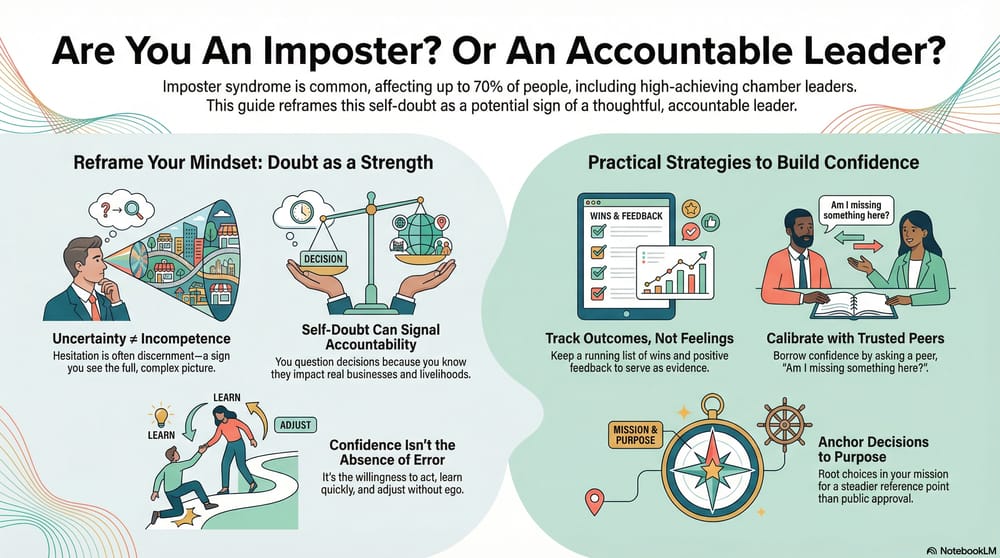
Confidence is not the Absence of Error.
It’s the Willingness to Act Despite It.
That distinction hits close to home for chamber professionals because your work lives in uncertainty. Economic signals shift. Member expectations evolve. Political realities change mid-stride. There is rarely a single “right” answer, only a best decision based on today’s information.
Imposter syndrome creeps in when you mistake uncertainty for incompetence.
Thoughtful, self-aware people tend to see complexity more clearly. They notice nuance, recognize tradeoffs. They question assumptions. That awareness can feel like self-doubt, especially when you’re surrounded by louder voices who speak with absolute certainty. If you’ve ever found yourself saying “But what about…” in a meeting, you weren’t being sabotaged by a lack of confidence or insecurity, you were noticing the decision-making facets necessary for strong leadership.
Your hesitation isn’t weakness. It’s discernment. And when it's internal questioning (not external as you might get from the board), it helps you refine your approach.
Wrong Can Be Right
Chamber leaders who last, and lead well, are rarely the ones who are “seldom wrong.” They’re the ones who are willing to be wrong publicly, learn quickly, and adjust without ego. That’s not a personality trait. It’s a professional skill.
The problem comes when self-doubt turns inward instead of outward. When curiosity becomes self-criticism. When reflection becomes rumination. When you start thinking, “Maybe I’m not cut out for this,” instead of, “What’s the next smart experiment?”
One practical shift is to separate confidence from certainty. You don’t need certainty to lead a chamber. You need responsibility. Responsibility looks like asking better questions, inviting diverse perspectives, testing ideas, and owning outcomes. It looks like saying, “Here’s what we know, here’s what we don’t, and here’s what we’re trying next.” That posture builds trust far faster than pretending you have all the answers.
Chamber pros are known for their listening abilities. That’s a superpower when you take what you’ve learned from listening and apply it in the rooms where you’re helping to shape the future of the business community.
No Doubt Equals No Interest
People who are seldom in doubt often don’t feel the weight of impact. Chamber professionals do. You know your decisions affect small businesses, livelihoods, and local momentum. Of course you think carefully and replay conversations. That doesn’t make you an imposter. It makes you accountable and understanding of the risks involved.
There’s also a cost to unchecked self-doubt that chambers can’t afford. It shrinks ambition. It softens advocacy. It makes you pitch safer ideas when your community needs bold ones. Over time, that label of imposter syndrome doesn’t just limit you. It limits the organization’s relevance. Questioning the ripple effects of your decisions does not make you an imposter. It makes you a suitable leader.
Still not convinced?
Still think you're an imposter?
Track Outcomes, Not Feelings
One simple habit helps rebalance the equation. Track outcomes, not feelings. Keep a running list of wins, member feedback, partnerships formed, and problems solved. Not for ego. For evidence. On hard days, self-doubt has a talent for selective memory. Give yourself receipts.
Chamber leadership is not about being the smartest person in the room. It’s about being the connector, the translator, the steady hand when conditions change. If you sometimes feel unsure, it’s likely because you see the full landscape, not just your corner of it.
You can go one step further by externalizing your confidence instead of carrying it around in your head. When imposter syndrome flares up, it’s usually because everything feels internal and subjective. Move it back into the real world.
Get Out There
Borrow confidence when you need it. Keep a short list of people you trust. A board chair, a peer from another chamber, a connection on the Chamber Pros Facebook group, a longtime member. Not for reassurance, but for calibration. A quick “Am I missing something here?” often reveals that you’re not behind. You’re just in the middle of complexity.
Name the feeling without giving it authority. Saying “I’m feeling unsure” is very different from saying “I don’t know what I’m doing.” One is a passing state. The other is a verdict. Choose your language carefully, especially with yourself.
Anchor decisions to purpose, not approval. Chambers exist to serve the broader business community, not to win a popularity contest. When you root your choices in mission, advocacy, and long-term impact, you give yourself a steadier reference point than applause or silence.
Finally, remember that growth often feels like exposure and is naturally a little frightening (we’re created that way). New rooms, bigger conversations, higher stakes. That discomfort doesn’t mean you don’t belong. It usually means you’ve leveled up.
Imposter syndrome loses its power when you stop treating it like a warning sign and start recognizing it for what it is--evidence that you’re stretching into work that matters.
Share this post...
Most Recent Posts
Are you using lead magnets at your chamber? You should be. Here's why you should, how to get started, and even ideas on creating your own.

Do you want a more diverse chamber where everyone feels welcome? Maybe there's a demographic you know could benefit from chamber membership and you want to reach them in a more meaningful way. These ideas can help
Retention is a great thing and showing your members that you value them is equally important. But should you thank them for renewing?
Your chamber board is one of your greatest assets (or biggest challenges). Here are a few basic tips to help you have an engaged and working board.
If you're a chamber pro, maybe you've wondered if you're actually doing everything you should for your members. While every chamber and community are different, there are things we all should be doing.

It happens to the best of us. No matter how much planning we do, sometimes a chamber event flops. Here's what to do what it happens.
Last week we covered how to help your member businesses thrive at the end of year. Now, we're looking out for you. Here are a few tips and facts to help you maintain your sanity.
The end of the year can be a busy time for some businesses. If they're in the race for holiday spending, these ideas can help.
Your small businesses work hard and they're the backbone of your economy, providing many jobs for the community. This is the ideal time to celebrate them.
For small businesses looking to drive sales during Small Business Season, social media can be one of the best (and cheapest!) ways to do it. In this article, we provide social media posts you can copy as well as several ideas for drawing a crowd.

According to a recent report, 43% of middle-class Americans will be spending less on gifts this holiday. If you're one of them, you need to shop local.
Are you trying to get your community to support shopping small? Then you need to educate them on the "why" and help them have fun doing it.
CONTENNT
Legal Agreements, Privacy Policy, Terms and Conditions
Copyright 2026 Chamber Pros Community and Frank J. Kenny, LLC