
At your annual review, the new board chair asks why you didn’t spend more time visiting businesses outside downtown. It’s a fair question. It’s also the first time anyone has raised it.
Last January, the board asked you to rebuild the ambassador program and improve first-year member retention. You spent the year doing both. Now you’re halfway through a conversation about whether you had a good year, and you’re working from different job descriptions.
The incoming chair may have spotted a real gap in the chamber’s outreach. That makes it a good conversation to have about the year ahead. It’s a lousy surprise to have in a performance review.
In a board transition, the annual review can get lost. It can also get diluted and mixed up if the new board chair has an interest in one thing, but you were expected to do another. While you are excited to have input from the new board chair, you don’t want it to look like you have not met expectations because you get caught in the awkwardness of a board transition.
If your new board takes office in January, you can use the next few weeks to settle how the board will evaluate its chief staff executive. Start with the existing strategic plan agreement or goal sheet. The board reviews the year against the expectations it set for that year. The incoming chair helps the board decide what to ask for next.
Audio Summary
Find Out Who’s Running the Review Before They Switch Seats
If you’re the chamber executive, ask your current chair for 20 minutes before the final board meeting of the year. Bring whatever the chamber already uses to guide evaluations, along with the goals the board approved. If the chamber has a review policy or a schedule tied to your employment agreement, work from those documents.
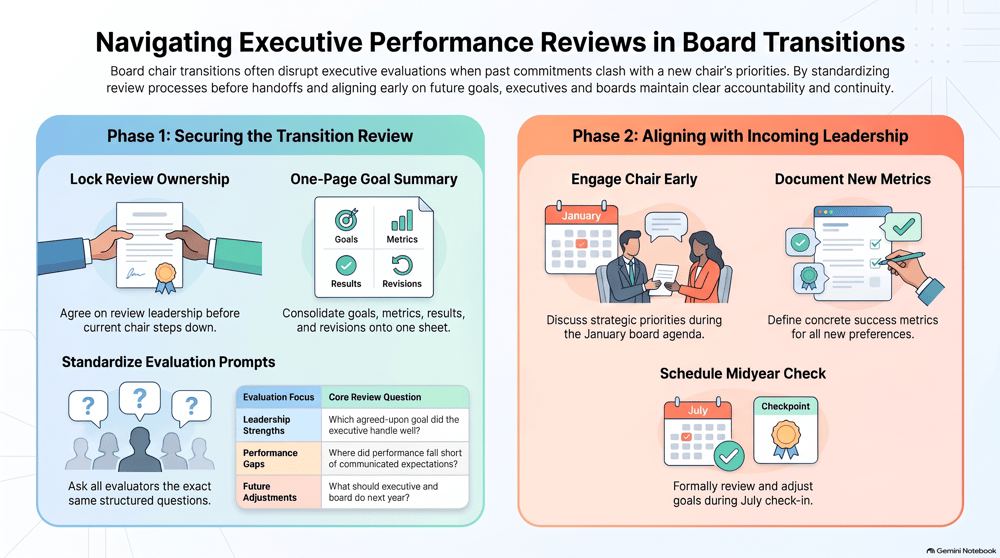
Before the current chair steps down, agree on who’ll run the review and put the date on the calendar. Write down who’ll gather board feedback, lead the conversation, and keep the confidential record.
If the executive committee runs the review, follow your chamber’s process for involving or updating the full board. Schedule next year’s midyear check-in, too, so the incoming chair knows when to revisit your goals.
If your review routinely happens after the new chair takes office, gather the outgoing chair’s observations before the handoff. Give them a few specific prompts tied to your goals. What progress did they see? Where did the work fall short? What board decisions or outside developments affected the outcome? Ask the person coordinating the review to capture that input while the details are fresh. A January chair can lead a December review with a much better picture of the year.
If you’ve never had a formal review, the leadership transition is a natural time to make it part of the board’s calendar. Every chamber executive should get a review each year. At your first planning conversation with the incoming chair, try, “As we set priorities for the year, could we agree on what success looks like and schedule time to review how I’m doing? I’d like to know what’s working and where the board wants me to improve.”
Ask the chair to bring the proposed review schedule to the board so the practice carries through the next transition, too.
Put the Year’s Commitments on One Page
You may have a strategic plan, a budget, a job description, and a dozen board packets that tell pieces of the same story. Pull the pieces the reviewers need into a short document. For each goal, record what the board agreed to, how it planned to measure progress, what happened, and any changes it approved along the way. Include the date of the original decision and any later revisions so reviewers can find the context quickly.
Say the board set a goal of increasing first-year renewal from 65% to 72%. You ended at 70%. In your self-assessment, show the result and explain what you learned. Maybe members who received a personal check-in within 90 days renewed more often, and your team reached only half the eligible members. That gives the board a concrete place to ask what got in the way and what it would take to reach more of them next year.
If the board shifted staff time in June to help businesses navigate a downtown construction project, record that decision and explain its impact on your work. If directors agreed to shift staff time and never discussed what that meant for your targets, surface that too. The review can account for the trade-off and give everyone a better way to handle the next one.
What if the board never gave you written goals this year?
Work together from the expectations you can document in the job description, the approved work plan, and board decisions. Be candid about where expectations were vague. You can still have a useful conversation about performance and what you’d do differently.
Save newly proposed targets for the coming year, when you’ll have a chance to work toward them.
Ask Every Reviewer the Same Questions
Board members see different slices of your work. The director who comes to every ribbon cutting can speak to what happens there. The treasurer sees how you manage cash flow and explain budget variances. Both perspectives can help, especially when reviewers connect what they observed to an agreed expectation.
Give everyone contributing to the review the same short set of prompts.
• Which agreed-upon goal or responsibility did you see the executive handle well? What did you observe?
• Where (if anywhere) did performance fall short of an expectation we had communicated? Give a specific example and explain the effect.
• What did the board do, or what changed in the community, that affected the result?
• What should the executive and board each do in the coming year to improve the outcome?
The person compiling feedback should ask for examples when a comment is too broad to act on. Take “I’d like to see more visibility.” Does that mean members seldom hear what the chamber is doing on their behalf? That the executive missed meetings with a coalition the board asked them to lead? Or that a director would personally like to see the executive at more breakfasts? Each is a different conversation. A useful review gives you enough detail to understand what actions need to change/evolve and how success will be measured.
Give the New Chair Something Meaningful to Shape
Put a conversation about the coming year on the January agenda. Ask the chair where they see an opportunity the chamber can act on and what they’ve heard from businesses. Then bring that idea to the board alongside the chamber’s existing commitments. That way you’re pulling them in immediately and not just having them continue as is.
For example, the chair may want the chamber to reach more employers in the industrial park. Ask what the chamber needs to learn from those businesses and what it could do with the answers. The board could agree to 20 employer conversations by June, followed by a report on the two most common barriers the chamber can help address. The chair can contribute by opening a few doors. If the work requires substantial staff time, agree on where that time will come from. A goal that goes on the calendar needs room on the calendar.
Write down what success looks like, when progress check-ins will occur, and what the board has agreed to provide. If the chair prefers a monthly dashboard, talk through what decisions it would help directors make and whether a short update in the existing board packet would meet the need.
The chair’s preferences can improve how you work together. When a preference adds a new performance expectation, get board agreement and document when it takes effect.
Make it Easy to Adjust in July
Sometimes an opportunity deserves immediate attention. A major employer closes. A partner offers to fund a workforce initiative if the chamber can take the lead. The annual goals need enough flexibility for the board to make those calls.
At your midyear check-in, ask the board to confirm what’s on track, where you need help, and whether any commitments should change. If the chamber takes on workforce meetings twice a month, decide together whether the fall seminar series moves to spring, gets a partner to lead it, or comes off the calendar. Write down the decision and update the goals you’ll use at the next review. If a performance concern surfaces in March, talk about it in March, agree on what improvement looks like, and set a follow-up date while there’s time to act.
After the annual review, make sure you and the board’s designated reviewer have the same written summary of what was discussed, what you agreed to work on, and when you’ll revisit it. Keep the review and handoff materials with the chamber’s confidential records so the next chair can pick up the process without having to reconstruct it.
Start with one sentence at your next meeting with the current chair. “Before we hand this off in January, can we agree on what we’ll use to review this year and when we’ll set next year’s goals?”
Bring the incoming chair two things in January. A short account of what the board asked you to do last year gives you a shared starting point for the review. A conversation about what local businesses need now gives the new chair a chance to shape the work ahead.
By the time the next chair takes over, you’ll have a full year of shared decisions to hand them, starting with the goals you set together in January.
Share this post...
Most Recent Posts

Hard conversations can be made better by being aware of the body's response and these tipds.

Do you love your chamber's annual meeting or is it time to spice things up? We have 40 creative ideas to do just that.

Change is hard especially when it involves a beloved event. Here are a few tips on how you can manage it.

Want to bring employees and employers together? Then it's time for a job fair. Here's how to put one together.

Isn't it time to move beyond table sales? Create sponsorships your investors will get excited about.

Want to get more done this year? You can't create more hours in the day but you can do these things:

Key trends, strategies, and tools chamber professionals need to thrive in the coming year. It’s your roadmap to growth, engagement, and innovation in 2025.

Conducting an end-of-year assessment has a lot of advantages for your chamber. Here's how you do one.

Introverts have a secret power when it comes to personal connections. Here's how you can leverage it in the chamber world.

Anniversaries are a big deal. It's a time to show the community your chamber is the voice of business and has been for a while.

If you have a visitor's center or are thinking about adding more travel info to your chamber office, here are a few ideas.

This guide helps chamber pros choose member management software by identifying needs, researching options, and comparing costs.
CONTENT
Legal Agreements, Privacy Policy, Terms and Conditions
Copyright 2026 Chamber Pros Community and Frank J. Kenny, LLC