
Heading up a chamber can often feel like that scene from the movie Jerry McGuire where Cuba Gooding Jr., exclaimed, “Show me the money.” If only it were that easy. Instead, you probably feel like one of your primary duties is chasing members, sponsors, and other investors. It can be exhausting.
Across the chamber world, the same themes keep surfacing: back-to-back events, pressure to bring in revenue, bigger sponsors harder to land, and teams that are already stretched thin. Sponsorship, which used to feel relational and energizing, can start to feel like an impossible pursuit.
The problem is not your effort. You’re trying. We all see it.
The problem is structure.
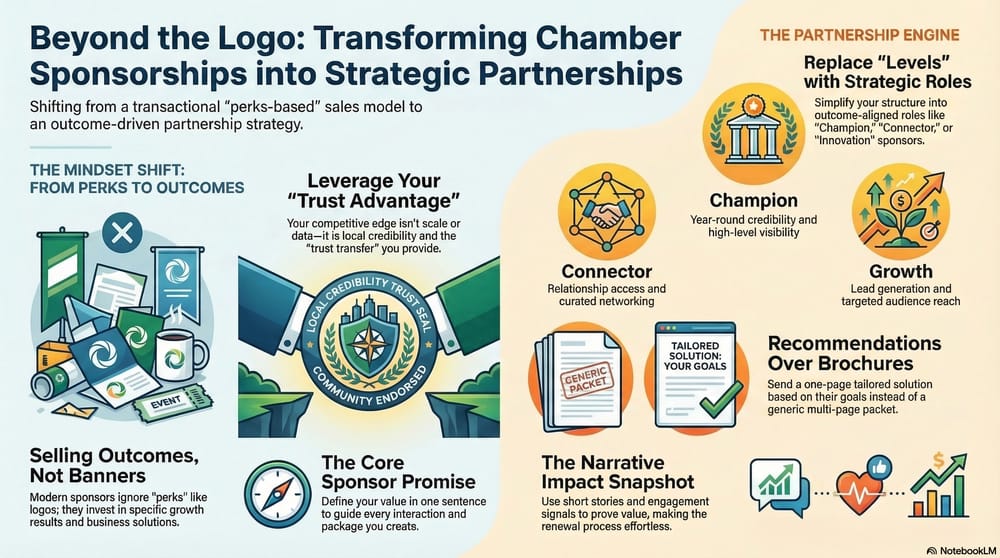
Many chambers are still selling sponsorship like a collection of perks. Logos on banners. Social media mentions. A table of eight. Maybe a microphone moment, if someone upgrades.
How else would you do it? Nothing’s wrong with that, right?
Wrong. Fewer sponsors are buying “perks” these days.
They’re buying outcomes.
When you shift from “benefits” to business results, sponsorship becomes easier to position, easier to sell, and easier to renew.
Why Sponsorship Feels Harder Now
Sponsors have more choices than ever and when you position your sponsorship as sheer exposure, they’ll start looking at it the way they do other marketing exposure. When a business invests in digital ads, influencer campaigns, direct email marketing, podcasts, or targeted social campaigns with dashboards full of analytics, a list of logo placements doesn’t hold up.
Your advantage is not scale. It’s trust.
The chamber has much more to offer than just data. It’s a perfect blend of civic leadership and community credibility. Alignment with the chamber signals seriousness and commitment to the local economy. That kind of trust transfer is hard to buy elsewhere.
But you must articulate it clearly. Instead of selling exposure, sell positioning. Instead of selling perks, sell leverage.
Start With a Clear Sponsor Promise
Before you redesign a package or change a price, define your core sponsor promise in one sentence.
For example:
“We help you build trust locally and connect with decision-makers through high-credibility visibility and relationship-based access.”
That sentence should guide everything.
Then tailor it by sponsor type.
- For a financial institution: positioning as the trusted growth partner for local business.
- For a healthcare system: visibility tied to community wellbeing and employer engagement.
- For a major employer: talent pipeline access and employer brand elevation.
- For a developer: credibility and relationships in a highly visible public environment.
When you connect sponsorship to a sponsor’s actual growth pressure, the conversation feels strategic, not transactional.
Create Sponsor Roles, Not Endless Levels
It’s exhausting to manage dozens of disconnected sponsorship levels across multiple events and ensure everyone gets what they signed up for.
Simplify.
Create a small set of sponsor roles that align with business outcomes.
For example:
Champion Sponsor: year-round credibility and visibility
Connector Sponsor: relationship access and curated room presence
Growth Sponsor: lead generation and audience reach
Workforce Sponsor: employer branding and hiring alignment
Innovation Sponsor: thought leadership and future-facing positioning
You can still tier within these roles, but the structure becomes clearer. Sponsors can see themselves in a role. That clarity reduces back-and-forth and speeds up decision-making.
Send Recommendations, Not Brochures
Instead of sending a multi-page packet and hoping something resonates, send a one-page recommendation tailored to the sponsor’s goals.
Structure it simply:
- Their stated goal
- The sponsor role that aligns
- Specific placements that support that goal
- What success looks like
- How you will report back
This approach positions you as an advisor, not a fundraiser. It also reduces the fatigue of chasing. You are not asking for support. You are offering a solution.
Give Sponsors a Measurement Story
Sponsors do not need perfect attribution models. They want credible evidence that their investment mattered.
After a major sponsored activity, provide a short Sponsor Impact Snapshot:
- A short narrative explaining the value
- Warm introductions facilitated
- Visibility recap
- Engagement signals
- Audience profile and attendance
The narrative is key. Create context for the numbers. When sponsors can forward your recap to their leadership team and say, “Here’s what we gained,” renewals become easier.
Build a Repeatable Sales Rhythm
Sponsorship should not depend on your energy level or how many fires you’re putting out that week.
Create a simple rhythm. Identify your top 25 sponsor prospects.
Sort them into three categories:
- Strategic new fit
- Warm relationship
- Renew or upgrade
Lead with a short fit call. The goal is not to pitch. It’s to understand.
Ask: What are you trying to grow or protect this year? Who do you need to reach? What does success look like?
Then send a tailored recommendation. Close with meaningful, limited opportunities such as presenting roles, category exclusivity, or anchor sponsorship positions. This structure protects your time and builds consistency.
Where AI Can Lighten the Administrative Load
For chambers operating with small teams, capacity is often the real issue. AI can help with the repeatable, time-consuming tasks that drain energy.
AI can assist with:
- Creating internal workflows and SOPs
- Assembling Sponsor Impact Snapshot reports
- Writing renewal emails and quarterly sponsor updates
- Drafting one-page sponsorship recommendations
- Cleaning up call notes into clear summaries
- Drafting prospect profiles and organizing sponsor lists
AI’s especially helpful for drafting and organizing. It speeds up formatting, improves clarity, and reduces the time it takes to turn conversations into polished communications.
However, AI should not be making decisions on navigating political nuance, managing sponsor conflicts, or managing relationships. Those decisions require leadership insight, board alignment, and often expert guidance.
AI is an execution assistant. Strategy decisions remain human.
Shift From Chasing to Partnering
When sponsorship is framed as “help us fund this event,” you chase.
When it’s framed as “here is how we help your business grow, protect, and position itself locally,” you partner.
That distinction changes the emotional experience for you and the business leader across the table.
It also reduces burnout.
Because most chamber professionals aren’t struggling from lack of dedication. They’re struggling with a model that depends on constant activity without enough structure. By clarifying your sponsor promise, simplifying your roles, tailoring recommendations, and reporting impact clearly, you create a sponsorship engine that hums.
You stop chasing. You start advising. And in an environment where sponsors are scrutinizing every dollar, the chamber that positions itself as a strategic growth partner rather than an event vendor will win more often.
Stop selling logo placement.
Start leveraging access to a trusted local ecosystem. That’s a competitive advantage few organizations can offer.
Share this post...
Most Recent Posts
Looking for a few new topics for your chamber programming? Check these ideas out. Your members will love them.

Networking does wonders for business but only if you do it effectively. Showing your members how can be a huge turning point for them.
Delegation shouldn't make you feel guilty. It's simply a way to reallocate resources for the best chamber outcomes and it's time you started.
Small Business Season Heroes Spotlight, Delaware Small Business Chamber
Videos are a necessity these days but many people don't feel comfortable doing them. This article can help you get over that.
If you think your members aren't fans of politics right now, you may be right but that doesn't mean it's not a great time to get them involved in government affairs.
Sometimes relationships just don't work out. Membership is no different. Here's what you need to know about when and how to part ways.

Chamber pros have a stressful job but stress doesn't always have to be a hinderance. There are some benefits to stress.
Are you directly involved in the development of your community? Here's how and why you might want to consider it as a chamber pro.
Cliques aren't just tight groups of friends. They can be divisive and disruptive to your chamber mission. Here's how to deal with them.
Discover strategic insights and practical tips on how chambers can be a valuable resource for navigating uncertainties and fostering resilience.
Are you using lead magnets at your chamber? You should be. Here's why you should, how to get started, and even ideas on creating your own.
CONTENT
Legal Agreements, Privacy Policy, Terms and Conditions
Copyright 2026 Chamber Pros Community and Frank J. Kenny, LLC