

The new member packet is more than a polite administrative formality. Yet many chamber pros go with the administrative/operation basics—a welcome letter, a brochure, maybe a complete list of benefits that nobody reads. The business owner nods, says thank you, and the packet quietly joins the graveyard of papers on, in, or under their desk.
That’s a waste of one of the most important moments in the member lifecycle.
The first few weeks after someone joins the chamber are the honeymoon period. They’re curious, optimistic, and actively wondering whether joining was a smart decision.
What you hand them during that moment sets the tone for everything that follows.
A new member packet should not feel like paperwork. It should feel like the beginning of a relationship. Like a door opening, a weight off their shoulders, a hopeful solution to help their business.
We’ll start with the basics and then provide you with a few creative ideas on how to deepen the budding member relationship. This packet contains a lot of paper.
Many of these ideas can easily translate to the digital world as well in the form of:
- a QR code where all these resources live (without the paper)
- an AI welcome assistant to answer any questions and take them through the onboarding process
- a welcome email campaign directing them to where they can find a different chamber resource each day
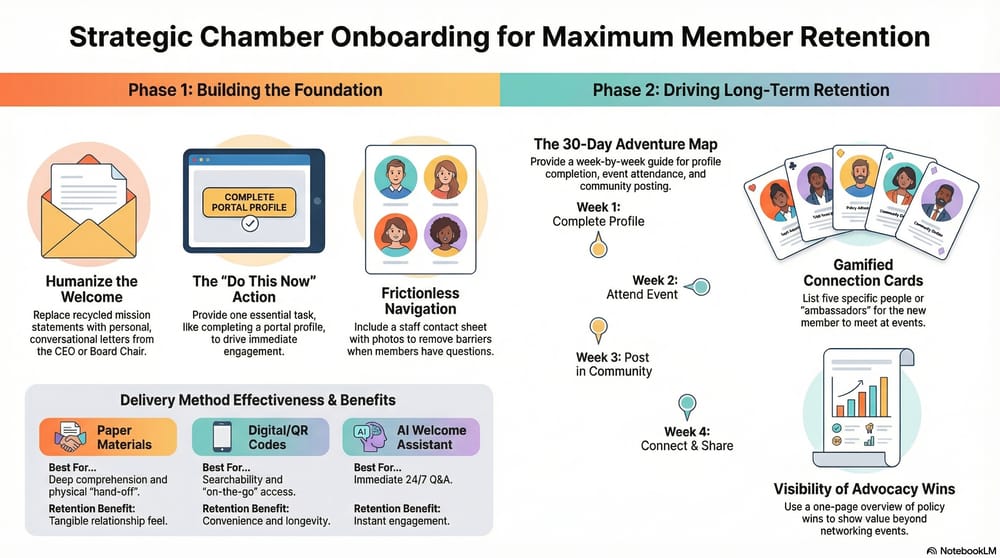
Whether you choose paper or digital will depend largely on the types of members you have, your print budget, and how environmentally conscious your community is. Keep in mind, they both have their benefits. People tend to comprehend and retain information slightly better when reading on paper than on a screen, especially for longer or more complex material. However, when searching for the information that you know “you saw somewhere,” digital is better. For retention and convenience, it is a best practice to do both. Give them something to hang onto while pairing it with a strong digital welcome campaign.
The Basics of a Member Welcome Packet
If a new member cannot quickly understand how to use their membership, the rest of the packet loses its impact. Research on nonprofit and membership organizations shows that organizational identification early in the relationship has a strong positive effect on how long someone stays a member. In other words, when people begin to see themselves as part of the group soon after joining, they are more likely to maintain that relationship. That’s why the contents of this packet are so important.
A Welcome Letter
A solid packet should include a short welcome letter from the CEO and/or board chair. Keep it personal and conversational, not a recycled mission statement. The goal is simple: “We’re glad you’re here and we want to help your business succeed.”
What They Receive as a Member
Include a clear overview of member benefits. Highlight the top five ways a member can get value immediately. Networking events. Marketing opportunities. Advocacy representation. Member directory exposure. Educational programs.
Include a quick mention of “Do this now” and include a suggestion that is essential to getting them involved and why it’s important. For instance, “Help members get to know you and get found by people who are looking for your type of business by filling out your member portal completely as soon as possible. These feeds into our online directory that sees 400 searches a day.”
Calendar and Contacts
Add a calendar of upcoming events for the next few months (or a postcard with the QR code link to the online calendar). New members often intend to go to something but never circle back to check the website. Put the opportunities right in front of them.
A staff contact sheet also helps. Don’t assume new members know who does what. A simple page with names, photos, and “what I can help you with” removes friction when members have questions.
Instructions
Finally, include instructions for setting up their member profile, posting job listings, submitting events/deals, or using whatever digital tools your chamber offers. If it requires more than three clicks, explain it or create a Loom video so they can follow along.
These things comprise the foundation. Necessary. Practical. But certainly not memorable.
Now let’s make it interesting. These ideas can be included as part of the packet or individually for the first few weeks. Pick and choose the ones that work for you. You needn’t do all of them.
Exciting Things to Include in a New Member Packet
A “first 30 days” roadmap: Most members join with good intentions and then get busy running their business. A simple roadmap helps them take the first few steps. This can be a printed one sheeter but this also works really well as an email welcome campaign.
Create a “Your First 30 Days at the Chamber” guide. Think of it like a short adventure map.
Here are a few suggestions:
- Week one: encourage them to complete their member profile and introduce themselves in the chamber’s online community or social channels
- Week two: suggest they attend their first event or schedule a quick introduction call with staff
- Week three: invite them to join a committee or volunteer opportunity
- Week four: encourage them to post a promotion, share a ribbon cutting, or write their first member news item
This simple structure answers the question new members rarely ask out loud: “What should I actually do now?”
Include a “member spotlight starter”: If you run member spotlights on social media or in your newsletters, instead of waiting months to feature someone, include a short questionnaire in the packet that helps you tell their story quickly.
Ask questions that go beyond the usual “tell us about your business.”
Try prompts like:
- What inspired you to start your business?
- What’s one thing customers might not realize about what you do?
- What problem do you love solving for people?
- What is one collaboration you would love to find through the chamber?
These answers give your marketing team ready-made content while also helping the new member feel seen.
Add a gamified “connection card”: Chambers exist to create connections so you don’t want new members walking into their first event not knowing anyone. A simple tool can help.
Create a small “connection card” listing five people they should meet in the chamber community. These could include:
- A staff member who runs a key program
- A community partner
- A business that serves the same customer base
- Another business in the same industry
- A chamber ambassador
There can be a space for others to sign off on it. It’s a forced icebreaker and gives the newbie an activity to get them through their first event even if they’re not a great networker. It’s something a chamber ambassador could also give them ahead of the event, starting them off with one signature—theirs.
When members feel connected early, retention climbs dramatically.
Something physical that represents the chamber: Yes, we live in a digital world. Humans still like tangible things. Consider including a small branded item that is useful. Not another stress ball destined for the junk drawer.
Ideas:
- A small notebook branded with the chamber’s logo.
- A “shop local” sticker or window decal.
- A local coffee shop gift card.
Even better, include something sourced from a member business. (Some chambers make this a sponsorship opportunity to add swag to the new member bag.) This quietly reinforces the idea that the chamber supports its member businesses.
Feature local member perks: Introduce the new member to the broader member network through perks. Create a small “member welcome perks” sheet where several existing members offer something small but meaningful. A free coffee. A discounted consultation. A tour. A trial class.
This accomplishes two things at once. It encourages the new member to explore the local business community while giving other members a chance to make the first introduction.
That way chamber membership becomes an entry to experience.
Make the advocacy work visible: Advocacy is one of the highest-value services chambers provide, yet new members rarely think about it. Include a short one-page overview of recent advocacy wins or policy priorities.
Focus on tangible outcomes like a:
- transportation improvement that benefits employees.
- workforce program developed with the city.
- zoning change that helped businesses expand.
This helps members understand that their dues support something bigger than networking events and it’s something they need that they often can’t do for themselves.
Invite them into the story: One of the most powerful additions to a new member packet is an invitation to participate.
Ask them one simple question:
“What does success look like for you this year?”
Provide space for them to answer it or ask them to email their answer.
When you review those answers, you gain valuable insight into what the member actually wants. Growth. Hiring. Visibility. Partnerships. Advocacy support. Now the chamber can help them move toward that goal instead of guessing.
You want the packet to become the beginning of a conversation and then a relationship. Make it feel like a welcome, not a transaction. The best new member packets feel thoughtful, not salesy. They show that the chamber is paying attention.
Instead of handing someone a stack of documents, you are giving them a guided introduction to a community designed to help them succeed. If the first impression says “You belong here, and we’re excited you joined,” the relationship starts in exactly the right place.
And if that honeymoon phase turns into real engagement, the chamber will not just gain a member. It will gain a long-term advocate for the entire business community.
Share this post...
Most Recent Posts
The best chamber ambassador programs do far more than greet people at events. They deepen member engagement and create a stronger sense of belonging.
Here’s how chamber pros are using smarter content strategies and AI tools to create newsletters people actually open, click, and remember.

Need fresh ways to champion local businesses beyond Small Business Week? These quotes, slogans, and community-minded messages can help.

Chamber events can lose momentum when it's the same faces and the same format every time. Maybe it's time for a few multi-chamber event ideas.

Some Business After Hours events are struggling, but many just require a realignment to meet members' needs.

New chamber CEOs face big expectations. This article shares practical advice from experienced chamber pros on what to do first and what to avoid.
Fresh event names and themes can help chamber programs stand out and attract attendees. Learn how creative naming ideas, and event themes can bring new life to events.

A chamber annual report can do more than recap the year. Use annual reports to prove impact, build trust, support retention, and tell a stronger story to members and community leaders.

Flexible schedules help chambers retain good staff, reduce burnout, and stay competitive against larger employers. Learn real chamber examples and practical ways to offer flexibility.

Need funding to do bigger community work? Learn how a 501(c)(3) foundation can help chambers pursue grants and expand their impact.

Is your board chair retiring? It's time to show some recognition with these meaningful ideas.

Don't spend your time doing what's already been done. Start with these chamber job descriptions.
CONTENT
Legal Agreements, Privacy Policy, Terms and Conditions
Copyright 2026 Chamber Pros Community and Frank J. Kenny, LLC