

Chamber currency programs can be a big win for local businesses. But they serve more than just individuals looking to give a local gift. Here's a way to make sure your chamber bucks program gets a lot more interest:
A local employer wants to give 100 employees a $50 year-end thank-you. Someone has to pick a gift that works for the night shift, the new hire who just moved to town, and the employee who hates everything.
Your chamber could give that employer one invoice and give each employee $50 to spend at a participating local business. One person buys dinner. Another puts it toward a haircut. The new hire tries the bookstore everyone keeps talking about.
The employer gets the gifts handled, and local businesses get a share of a $5,000 purchase they might never have had a chance to compete for individually.
That’s the appeal of chamber currency. There are many ways to implement it, some with administrative duties, others without.
Audio Summary
What Are People Buying?
Chamber Bucks, community gift cards, shop-local certificates. Whatever you call it, the basic idea is the same. A buyer pays for a set dollar amount that the recipient can spend at participating businesses. The chamber organizes the network and may issue and administer the certificates itself or work with a provider. The format determines how the merchant gets paid and who handles problems.
The Armstrong Spallumcheen Chamber of Commerce, for example, issues certificates that businesses bring to the chamber office for reimbursement. The Steamboat Springs Chamber uses a digital card powered by Yiftee. Buyers can send it by email or text, and participating merchants process it as a card payment. The Michigan West Coast Chamber of Commerce also uses a technology partner in their West Coast Cash program to keep their dollars local.
Doing it yourself or using a tech partner both give recipients a choice of local businesses, but the work behind the counter looks very different.
Why Chambers Get Behind It
A chamber currency program gives your shop-local message a purchase button. It also gives employers a practical option for staff recognition, client gifts, and welcome packages. A hospital might order cards for employee appreciation. A conference organizer could give speakers something they can use while they’re in town. A real estate office (or corporate HR working with relocations and hires) could include a certificate and a merchant list in its closing packet.
For merchants, the upside is a chance to earn a visit from someone who hasn’t visited before. A garden center can be part of the same gift as a pizza place or a bike shop. A recipient who spends more than the certificate balance brings additional sales to that business.
For the chamber, redemption makes the program easier to explain to the board. “Participating businesses redeemed $18,000 this year” tells a more useful story than how many people saw your holiday campaign. It measures dollars spent through the program. Use merchant feedback to learn how much of that spending brought in new customers or generated purchases above the card balance.
Run It Yourself, Use a Provider, or Share the Work
There are several ways to implement one:
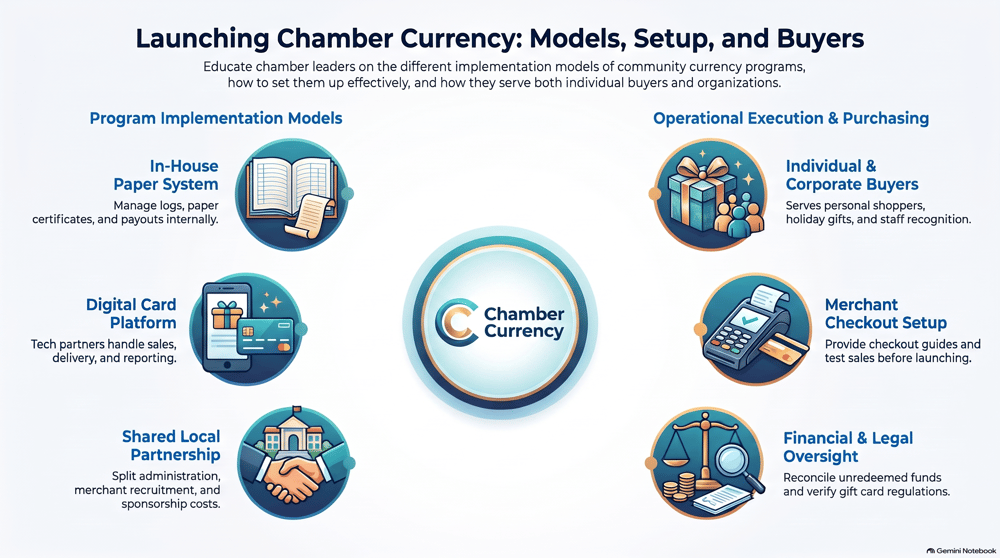
Issue paper certificates in-house. This can fit a chamber with a manageable merchant list, local buyers who are comfortable with paper, and someone available to handle reimbursements. Choose denominations, number every certificate, log each sale, and require the original for reimbursement. Set a predictable payout schedule.
An employer can hand out paper at a staff meeting, and merchants can accept it without changing payment systems. Your staff handles sales, records, payouts, and exceptions. Price that time into the decision, especially if your busiest buying season coincides with your biggest events.
Work with a digital gift card provider. This can make sense if people want to buy after hours, send gifts remotely, or place bulk orders for employees in multiple locations. Depending on the provider, the platform may handle issuance, delivery, merchant payments, balance checks, and reporting.
Ask for a live demo with the actual point-of-sale systems your merchants use. Have a cashier run a purchase that exceeds the available balance and complete it with another payment method. Find out what happens if the buyer sends the gift to the wrong email address or the card declines during Saturday lunch.
Share the work with a local partner. If the downtown association can recruit merchants and a local employer can commit to the first bulk order, your chamber may be able to bring a viable program to market with less staff time and a ready customer. The partners can choose paper or digital.
Put the responsibilities in writing, including who issues the certificates, holds funds, updates the merchant list, and answers customer questions. A sponsor can also pay for printing, platform fees, or a limited promotional bonus. Specify who funds the bonus and track it separately from purchased value.
Set Up the Checkout Before You Sell the First Card
Build the merchant list around places recipients can use throughout the year. A few dependable businesses across categories such as dining, retail, recreation, and services give people a reason to carry the card. Set a clear participation policy, especially if you want the program to promote chamber members or cover a specific district. Publish eligible locations and tell buyers about any restrictions before they pay.
Give each business a one-page checkout guide. Cover how to accept payment, how to handle a purchase above or below the available amount, what to do with a return, and whom to call when something goes wrong. With paper, decide how you’ll handle partial use before choosing denominations. With digital, check whether merchants can take the card online, in person, or both. Test a sale, a refund, and a merchant payout before the public launch. Ask a frontline employee to do the test using only the instructions you gave them.
Watch the Money and Read the Contract
Keep outstanding balances visible. For an in-house program, reconcile amounts issued, redeemed, reimbursed, voided, and still outstanding. Have someone review the reconciliation independently, even if that means asking your treasurer to review the records monthly in a one-person office.
Avoid counting unused balances as spendable chamber revenue. Ask your accountant how to record funds and fees, and have counsel check which gift card, disclosure, and state unclaimed-property rules apply to your design before you set any expiration or fees. Federal Regulation E includes gift card requirements and exclusions that can depend on how the program is structured.
Get the full cost of a provider in writing. Ask about setup, subscriptions, purchase and processing fees, merchant costs, branded cards, and bulk orders. Identify the issuer and who holds funds and handles refunds, disputes, fraud, and merchant payouts. Find out what transaction data you can export. Ask exactly how customers will use outstanding balances if you switch vendors, a merchant closes, or the program ends.
Start With a Buyer Who Already Has a Reason to Order
Before you put a new program on next year’s calendar, talk to the employers and organizations that already buy in groups. Ask when they order, how much they spend per person, how they distribute gifts, and whether they need an invoice or a purchase order. One committed buyer and a small network of trained merchants can tell you more than a big launch with a few people who said they’d sign up.
After the first round, look at dollars sold and redeemed, how many merchants actually received spending, and how much staff time it took to get each order out the door. Ask cashiers what tripped them up. Then call the person who ordered the first batch. If the gifts were easy to distribute and employees had places they wanted to use them, ask what else is on their calendar.
That $5,000 holiday order might be the start of a relationship that sends customers through local doors all year.
Share this post...
Most Recent Posts
Make your message a compelling one by using this copy writing technique.

Do people love your annual gala? What about you? Is it still paying off for the chamber?

Do you feel like Imposter Syndrome is hurting your career? It might be helping more than you think. Use these reframes.

Are all of your events pulling their weight on your roster? Or do some of them need to do more?

Do you feel guilty every time you take a moment for yourself? Here's how to right that ship.

Don't have time for a workforce initiative, you can still be a workforce hero through strategic micro actions
These simple ideas will help you get more structure in your day so you can accomplish even more.

AI is changing the world. How can your chamber help guide that in your community?

Do you need to update your chamber's policies and SOPs? If so, here's a comprehensive list of what you should think about including.

Do you visit your members but want to make a more memorable impression? Try these ideas.

Is your member growth stagnating? It might be because you have a leak in your funnel.

Is it time to revamp your About Us page? It's one of the most visited outside of the homepage. Make it work for you.
CONTENNT
Legal Agreements, Privacy Policy, Terms and Conditions
Copyright 2026 Chamber Pros Community and Frank J. Kenny, LLC