
You’ve scheduled a ribbon cutting, invited the board, and received two responses. One is a decline.
For a chamber executive trying to make a new member feel welcomed, that can sting. Meanwhile, a board director looking at a packed work calendar may wonder how attending another ribbon cutting fits the role they agreed to fill.
Both have a reasonable point.
Should board members be required to attend ribbon cuttings, new member onboarding sessions, and other chamber events? The answer depends on the board’s responsibilities, the chamber’s capacity, and what directors understood when they accepted the position.
The disagreement often begins with two different definitions of board service.
Audio Summary
The Case for Requiring Attendance
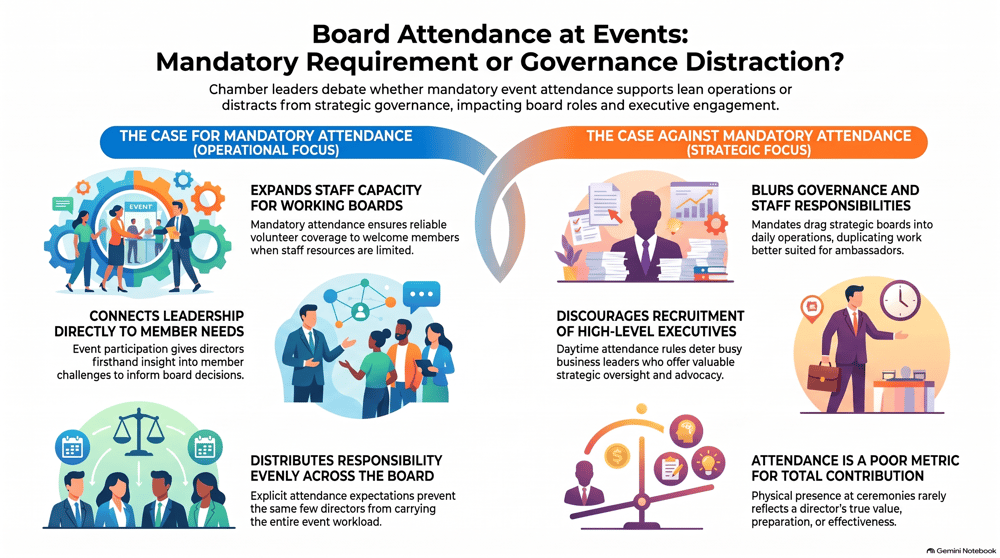
For chambers with working boards, participation is part of keeping the organization running. Directors help welcome members, make introductions, support events, and take on tasks a small staff couldn’t otherwise accomplish.
In that setting, an attendance requirement can serve a practical purpose. If the chamber needs three people to greet new members, someone must commit to being there. An invitation that everyone treats as optional leaves staff scrambling.
There’s also a member experience argument. A business owner celebrating an opening may appreciate meeting a chamber director who took time to attend. At onboarding, a board member can introduce a newcomer to people who could become customers, partners, or referral sources.
That interaction gives directors something useful, too: firsthand exposure to the people their decisions affect.
A board discussing retention may hear a different story after talking with a new member who still doesn’t know how to use their membership. A director considering changes to programming may learn something from an owner who can only attend before work.
Event participation creates opportunities to listen. It also helps directors understand what staff delivers and what members expect.
A Requirement Can Spread the Work
Without agreed expectations, the same few directors may appear at every event while others rarely participate outside board meetings.
A reasonable time commitment can distribute that responsibility. It can also help prospective directors decide whether they have time to serve before accepting a seat. If attendance is a requirement, that must be conveyed prior to swearing them in.
To avoid any questions, Chamber Pro Cristie Ann Andrews suggested, “Have it added as a part of your chamber’s bylaws. They have to attend and be a part of most events while serving on the board as a stipulation and expectation from the very beginning.”
Chamber Pro Kira Zavala takes an active approach to getting her board members there. “I send the board calendar invites. And I remind them at each board meeting. I also, am working to recruit board members who will be engaged. I’ve also kept in communication with my board chair and have asked her to be a cheerleader. For example, she will bring it up at a board meeting and communicate the importance and ask who can attend. I’ve also communicated to them that it has been mentioned to me many times about the board, not being present, and that it is a concern to me, and then I ask for direction and propose the question to them to facilitate the conversation.”
The strongest argument for mandatory attendance is straightforward: when hands-on participation is an agreed part of the position, the chamber should be able to count on it.
The Case Against Requiring Attendance
A chamber may recruit board members for financial oversight, strategic planning, advocacy, industry knowledge, or access to decisionmakers. Those contributions take time, even when they don’t produce an event photo.
A board member who helps resolve a workforce partnership issue or opens the door to a major employer may make a substantial contribution without attending that month’s ribbon cuttings.
For a board designed primarily around governance and strategy, requiring frequent event attendance can pull directors toward operations, which often ends in the board becoming too involved in what should be staff responsibilities. It can also discourage otherwise strong candidates whose professional schedules offer little daytime flexibility.
A hospital executive, manufacturer, small business owner, or school leader may be able to prepare for board meetings and lead a specific initiative while struggling to leave work whenever a business celebrates an opening.
Seniority alone shouldn’t excuse someone from agreed responsibilities. Still, the chamber should consider what it recruited that person to accomplish and whether its attendance expectations support that purpose.
Ambassadors Have a Role to Play
If a chamber has an effective ambassador program, ribbon cuttings and member welcomes may already have a natural home.
Ambassadors can develop relationships with new members, explain opportunities, make introductions, and follow up after events. Asking every board member to duplicate that work can blur responsibilities and consume time the chamber needs elsewhere.
Board participation can complement an ambassador program. A rotating director could welcome an onboarding group, for instance, while ambassadors handle the ongoing relationship.
But an ambassador team shouldn’t be treated as incomplete simply because the full board isn’t standing behind the ribbon.
Attendance Can Be a Weak Measure of Contribution
A director can attend regularly and contribute very little. Another may attend fewer events while preparing thoroughly, asking useful questions, making introductions, and following through on assignments.
An attendance count is easy to track. Board effectiveness takes more judgment.
An overly rigid policy can reward visibility while overlooking consequential work. It can also create resentment if board members feel their contributions are being discounted because they missed a ceremony.
April Brooks Bragg, President & CEO of the Robins Regional Chamber of Commerce said, “Our board’s primary role is governance and strategic direction, so we don’t put the expectation on them to populate ribbon cuttings or every Chamber event.
We don’t have an ambassador program either, but we’ve approached ribbon cuttings a little differently and still get great turnout. We encourage the member to treat the ribbon cutting like their own party, with us helping them make it successful and document the celebration.
We ask them: Who should be here celebrating with you? Invite your family, employees, customers, neighboring businesses, your accountant, commercial banker, insurance agent, vendors, and people you’d like to do business with. We invite elected officials and other community partners as appropriate, and we have a faithful group of members who tend to show up regardless.
That shift has made a big difference. Instead of feeling like Chamber staff has to recruit people to ‘show up’ for someone else’s business, we’re helping the business bring together its own network and community. The Chamber adds the structure, visibility, connections, and celebration, but the crowd doesn’t have to be our responsibility alone.”
The strongest argument against mandatory attendance is that directors’ time should follow their agreed responsibilities and the chamber’s priorities.
Set Expectations for Your Board
Whatever you decide is the right approach for your board (and how you might alter your bylaws to reflect it), work through these questions with the board itself.
What work needs to happen? Identify the actual need. Is it greeting new members, providing volunteer coverage, strengthening relationships, or demonstrating board support? Each may call for a different arrangement.
Who should own that work? Assign responsibilities among staff, ambassadors, committees, and directors. A staffing gap deserves a direct conversation about capacity.
Does every board member need to attend? A rotating schedule may provide reliable board representation without requiring the entire board at every event. Give directors a defined role when they arrive, such as welcoming guests or making introductions.
What commitment is realistic? Consider event volume, notice, travel, work schedules, and the other responsibilities directors carry. A chamber holding four ribbon cuttings a year faces a different question from one holding four a week.
How will contribution be assessed? Review event participation alongside preparation, committee work, introductions, and completion of agreed assignments. If someone repeatedly misses commitments, discuss the pattern and their capacity to serve.
Document the resulting expectations and share them during recruitment and board orientation. Distinguish required activities from encouraged ones. If you’re considering formal consequences for missed events, check how the proposed policy fits your existing bylaws and board policies before promising automatic enforcement.
What are your thoughts? Should chamber board members be a part of welcoming new members and businesses? Join the discussion here.
Share this post...
Most Recent Posts

Have a goal that you can't quite hit? Might be time to bring someone else in.

A successful women's initiative isn't just another networking event. Here's how you can design lasting impact.

Learn how to reduce sponsor fatigue and create sponsorship programs that withstand unexpected setbacks.

Some members just don't "do" events. Here's how you can reach them anyway.

Business leaders aren't disengaged. They're overwhelmed by competing priorities and information overload. Here's what you can do to cut out the noise.
Is LinkedIn an afterthought for you? It's one of the best places to build credibility and strengthen business with key decision-makers.

Video is an effective way for chambers to tell their story and attract new audiences. This guide covers everything you need to know.

Every chamber leader faces difficult personalities. If there's conflict, you need to learn how to respond to preserve trust and keep the chamber moving forward.

Members want visibility. Here are a few solid ways you can ensure they feel the value of membership.

Chambers are in a unique position to help members figure AI out. Here are a few programming ideas.
This practical reset guide helps chamber pros refocus priorities, fix momentum leaks, and create stronger member experiences.

Virtual chamber events may have surged out of necessity, but they’ve earned a permanent place in many engagement strategies. Here's why they still work.
CONTENT
Legal Agreements, Privacy Policy, Terms and Conditions
Copyright 2026 Chamber Pros Community and Frank J. Kenny, LLC